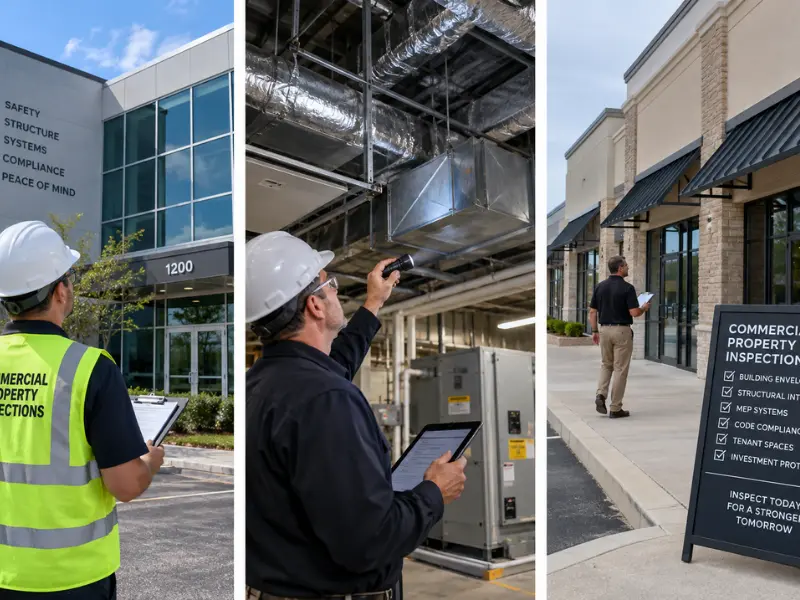
What Do Commercial Property Inspections Cover in Chandler?
It usually isn't called an inspection. Ask a lender and they'll ask for a PCA, a property condition assessment, and what they want back is a report with two cost tables in it. Those tables are the whole point, and they're why commercial work looks nothing like a residential report.
By Alex & Jeff, Certified Home Inspector · Last updated September 21, 2026
What Is a Commercial Property Inspection?
What does a commercial property inspection include varies more than the residential equivalent, because asset class decides scope.
The answer to what is a commercial property inspection depends on who's asking and why.
A buyer wants to know what's wrong. A lender wants to know what it will cost, and when. Those are different questions, and the commercial industry answers the second one through a defined process rather than a general walkthrough.
That process is the property condition assessment. It combines a walk-through survey of the building and site, a review of available documents, permits, maintenance records, prior reports, warranties, and interviews with property management or maintenance staff who know what's actually been happening. It's visual and non-destructive, like a home inspection, but the output is structured for underwriting rather than for negotiation.
So a commercial real estate inspection East Valley Phoenix buyers commission on a strip center, medical office, or flex building will typically be scoped as a PCA, whether the word appears in the proposal or not.
What Is a Property Condition Assessment?
So what is a property condition assessment, precisely? The industry standard is ASTM E2018, the Standard Guide for Property Condition Assessments, updated to its 2024 edition. It defines both the scope of work and the contents of the deliverable, which is called a Property Condition Report, the PCR.
The PCR contains two tables, and they do the real work.
Table | What it captures | Horizon | Who uses it |
Immediate Repairs | Deferred maintenance, failing or damaged systems, life-safety and code items | Short term, commonly within 90 days | Buyer negotiating, lender conditioning approval |
Replacement Reserves | Major components approaching end of useful life, projected capital spend | Long term, typically 10–12 years | Lender underwriting reserves, owner budgeting |
Two things about those tables are worth understanding before you read one.
The costs are opinions of probable cost, not bids. They're professional estimates drawn from industry cost data and experience. Nobody is guaranteeing a contractor will do it for that figure, and treating the numbers as quotes leads to arguments later.
The reserve table is a financial instrument as much as a technical one. A lender uses it to set required reserves. A buyer uses it to argue price. An owner uses it to budget. Which means the assessor's judgment about remaining useful life, how many years the roof or the rooftop units have left, moves real money.
The most common trigger for a PCA property condition assessment Chandler area owners commission is a loan transaction, and lenders often set the scope. Ask who the report is being written for before it's written.
What Changes Between Residential and Commercial?
Four things, and only the first is about the building.
The deliverable. A residential report describes conditions. A PCR quantifies them over a defined term. Our Chandler residential inspection guide covers what a home inspection includes by contrast.
The standard. Residential inspections in Arizona follow a defined standard of practice tied to state certification, which the Board of Technical Registration administers. Commercial has no equivalent state certification, the governing framework is ASTM, and the qualification comes from experience and, where opinions cross into design or structural adequacy, a registered professional engineer.
Access. A house is empty or occupied by one household. A multi-tenant commercial building means coordinating entry across tenants with their own leases and schedules, which changes both the timeline and how complete the interior coverage can be.
The lease decides what matters. This is the one people miss. On a triple-net lease the tenant carries maintenance obligations, so a finding that would be the owner's problem in one building is the tenant's in another. Read the rent roll and the lease abstracts alongside the report, because the same deficiency has a different owner depending on the paperwork.
When Is a Phase I ESA Needed?
Usually yes, and it's a separate product from the PCA.
A Phase I environmental site assessment looks at the property's history and setting for evidence of contamination. It's not about condition at all, it's about liability. Under federal law, an owner can be liable for contamination they didn't cause, and the protection is a documented pre-purchase investigation. The EPA calls that process all appropriate inquiries, governed by the AAI Final Rule at 40 CFR Part 312, and completing it is what lets a purchaser claim innocent landowner or bona fide prospective purchaser protection under CERCLA.
Two consequences. It has to happen before you buy, you can't acquire that protection retroactively. And it has to be signed by an Environmental Professional as defined in the rule, which is a different qualification from a building inspector.
Lenders on commercial transactions generally require one regardless. Prior use drives the risk more than current condition does, which is why it matters most on properties with industrial, automotive, dry cleaning, or fuel-handling history. Our industrial property inspection guide goes into the environmental scope in depth and covers which inspector handles industrial properties in Maricopa County.
How Much Does It Cost and How Long Does It Take?
Commercial property inspection cost depends on scope before it depends on size, since a general condition inspection and a full assessment are different products.
How much does a commercial inspection cost tracks building size, the number of separate systems and structures, tenant count, and the scope you commission. A single-tenant flex building is straightforward. A multi-tenant retail center with several roof sections, multiple rooftop units, and a dozen leases is not.
Scope drives price more than square footage. A baseline PCA to ASTM E2018 with both cost tables costs more than a general condition walkthrough, and it's what a lender will accept. A Phase I ESA is priced separately, and its timeline is longer, it depends on records requests rather than site time, so commission it first.
On duration: fieldwork on a small commercial building is typically a day. Larger or multi-tenant properties run two to four days, and multi-building sites are quoted per structure. Reports follow within several business days. The realistic constraint on a commercial deal is usually tenant access coordination rather than inspection time.
Anyone comparing the best commercial property inspectors near Chandler AZ, or the top rated commercial building inspectors in the East Valley Phoenix, should ask two things: what standard will the report follow, and who signs it where an opinion crosses into engineering.
Where Is the Commercial Stock in Chandler?
Chandler's commercial stock divides usefully by corridor.
The Price Corridor carries the newer office and technology-adjacent product, larger floor plates, substantial rooftop mechanical loads, and buildings young enough that the reserve table is about planning rather than deferred maintenance.
Downtown Chandler and the historic square run older and smaller, with mixed-use and adaptive reuse where permit history and accessibility questions come up more often.
The Chandler Airpark area and the industrial edges are flex and light industrial, where the environmental scope matters more and prior use is the first question.
Chandler Boulevard and Arizona Avenue retail is multi-tenant with a wide age range, where roof sections, parking lot condition, and how the leases allocate maintenance drive most of the findings.
We work across Chandler and Mesa, with commercial scope on our commercial property inspections page, the asset types we cover on property types, and the full area on our locations page. A commercial building inspector Maricopa County AZ investors engage works to the same framework wherever the asset sits.
If you've been searching commercial property inspection Chandler AZ, the first question isn't who to hire, it's what your lender needs the report to be.
People find us through a spread of searches: who does commercial property inspections near me, best commercial property inspector near Chandler, or who assesses commercial buildings in Chandler. Whatever the wording, commercial property inspections Chandler buyers commission start the same way, with a scoping conversation.
Two terms worth understanding. Commercial building assessments Chandler owners request can mean anything from a condition walkthrough to a formal capital-planning exercise, so the word alone does not tell you what you are buying. Property condition assessments Chandler lenders ask for usually means the ASTM E2018 product above, with its own report structure and reserve table. If you are asking which inspector near me performs property condition assessments, get the lender's requirement in writing first.
Frequently Asked Questions
1. How much does a commercial property inspection cost in Chandler?
Scope drives it before size does. A general condition inspection of a single-tenant suite and a full Property Condition Assessment on a multi-building asset are different products and should not be compared on price. After scope: floor area, the number of separate structures and tenancies, building age, and how many specialised systems are present, since commercial kitchens, medical infrastructure and process equipment each add time. Quotes come from a scoping conversation, and they are free.
2. Do you perform property condition assessments to the ASTM E2018 standard?
Work out whether you need one first, because that changes how much the answer matters. A PCA to E2018 produces a Property Condition Report with an immediate-repairs schedule and a replacement-reserves table covering roughly ten to twelve years, stated as opinions of probable cost rather than bids. Lenders on institutional deals commonly require it, and it is usually a multi-disciplinary exercise. Many private transactions need a general condition inspection instead, where a PCA would be over-specified. Ask your lender in writing which they require, then confirm scope before engaging.
3. What commercial property types do you handle?
Chandler's commercial stock runs across light industrial and flex space, office and medical suites, retail and restaurant units, and multi-family. Each brings different systems, so four things shape the engagement: how many separate structures, total floor area, which specialised systems are present, and whether a lender has specified a standard. Those four also determine whether one inspector is appropriate or whether the asset needs a multi-disciplinary team.
4. How long does the assessment and report take?
Field time runs from about a day on a single-tenant suite to much longer on a multi-building property with several rooftop units and decades of tenant improvement. On larger assets it becomes a sampling exercise rather than an inspection of every unit, and how that sample is selected is worth asking about. Report turnaround is longer than residential because the capital-planning element takes time to assemble properly. A same-week report on a complex asset usually means something was skipped.
5. Can you work to a lender or due-diligence deadline?
Give us the deadline at first contact, since it determines whether the work can be done properly rather than quickly. Commercial due diligence periods are negotiated and longer than residential ones, but the work inside them runs in sequence: an assessment can surface something needing a structural engineer, roofing consultant or environmental professional, each with its own lead time. Book at the start of the window rather than the middle.
Contact Halcomb Property Inspections
Halcomb Property Inspections Serving Chandler, AZ and the East Valley Phone: (480) 273-9328 Hours: Monday–Sunday, 6:00 AM – 9:00 PM Serving Chandler including the Price Corridor, downtown Chandler, and the Airpark area, plus Mesa, Gilbert, and the wider Phoenix metro.
Under contract on a commercial building? Request a free quote or call (480) 273-9328, and we'll scope the assessment against what your lender actually requires.
