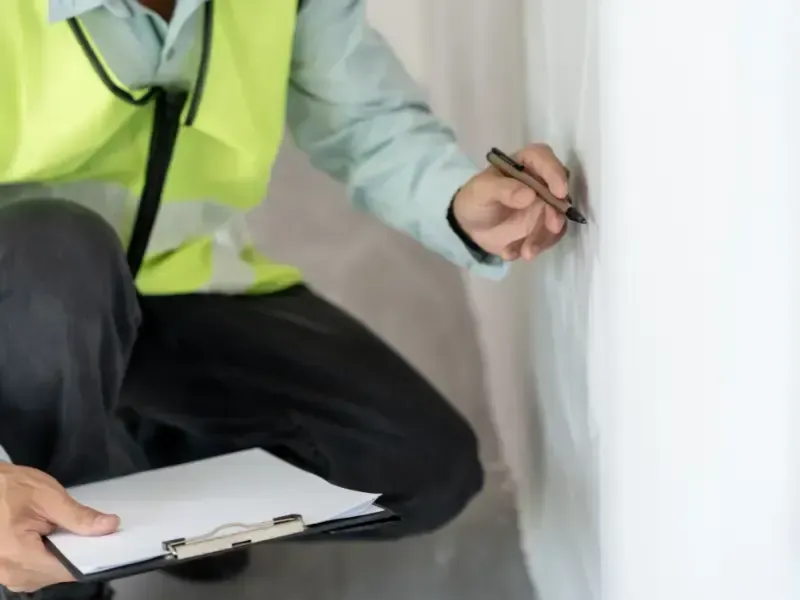
What Does a Foundation Inspection Cover in Paradise Valley?
The same things everywhere, plus one question that barely arises on a flat lot: does this house sit on native ground, on engineered fill, or across the line between them? The Town's own Hillside Building Committee figures put roughly 1,000 of about 6,800 parcels in the Hillside category — about one lot in seven — and on those the answer matters more than the soil does.
By Alex & Jeff, Certified Home Inspector · Last updated August 26, 2026
The Cut and Fill Line
Start here, because it explains most hillside foundation problems and almost nothing written about Arizona foundations mentions it.
What does a foundation inspection include on sloped ground? Start with how the pad was made. Building on a slope means cutting into the hillside uphill and filling downhill — Article XXII of the Town's zoning ordinance defines cut as land surface shaped through the removal of soil, rock or other material, and treats grading and excavation as development in their own right.
The consequence for the structure is straightforward. Native ground that's been cut into is done settling. It was compacted by geology over a very long time. Engineered fill is not. However well it was placed and compacted, it will consolidate further under load, and it does so on its own timetable.
A house sitting entirely on cut is stable. A house sitting entirely on fill settles more or less uniformly, which the structure often tolerates. A house spanning the line between them settles unevenly — and differential movement is what cracks foundations, racks door frames, and separates finishes. Uniform settlement is usually cosmetic. Differential settlement is structural.
So on a hillside property, a foundation condition inspection asks where that line runs and whether the crack pattern lines up with it. A diagonal crack in the same place on both storeys, directly above where the pad transitions, is telling you something specific rather than something general.
Are Retaining Walls Part of the Foundation?
The second hillside-specific point, and the one owners most often treat as landscaping.
On stepped and terraced lots, retaining walls frequently hold up the building pad itself. If that wall moves, the ground the house sits on moves with it. So a leaning wall, a bulging course, cracked or displaced blocks, or weep holes that have stopped weeping are structural findings on these properties — not a garden maintenance item.
Three things get looked at. Movement: is the wall plumb, and is there a consistent lean or a localised bulge? Drainage: functioning weep holes and a working drain behind the wall, because hydrostatic pressure is what pushes walls over. And the relationship to the structure: how close is the wall to the building, and is it carrying pad load or just soil?
Our Paradise Valley home inspection guide covers how this fits into a full inspection on large-lot properties.

Where the Water Goes?
On a flat Mesa lot the moisture story is irrigation soaking into expansive soil. On a Paradise Valley hillside it's different — water arrives from above and has to be taken somewhere.
Hillside sites are graded with engineered drainage paths, and the Hillside Building Committee reviews grading and drainage as part of its remit under Article XXII. The problem is that those paths are twenty or forty years old on an established property. Swales silt up. Owners landscape across them. A new patio interrupts one. And once the designed route stops working, water finds its own, which is usually along the path of least resistance — often straight at the fill side of the pad.
What we look for: swales that still function, discharge that clears the structure rather than pooling against it, roof drainage terminating well away from the pad edge, and irrigation on the uphill side that's effectively watering the fill. Mature, heavily irrigated landscaping directly against a hillside foundation is the single most common contributor we see.
Slab and Post-Tension Foundations
Yes, both, and the identification matters before anything else.
Paradise Valley's mix runs from mid-century homes on conventional slabs and stem walls through to newer custom builds on post-tensioned slabs. A slab foundation assessment starts by establishing which you have, because the reading changes completely.
A conventional slab cracks as it cures and moves, and most of that cracking isn't structural. A post-tensioned slab shouldn't crack much at all, so a crack on one carries far more weight and goes to an engineer sooner. Post-tension also constrains what can be done afterwards — you can't cut, core or drill into one without locating tendons first. Our Mesa foundation guide covers post-tension identification, the warning plaque, and the tendon anchor points in detail.
On a hillside property, add stepped footings and, on steeper parcels, piers or caissons founded into rock. Those are excellent foundations. What's worth checking is the transition — where the stepped or piered portion meets a slab-on-grade section over fill.
What an Inspection Does and Doesn't Do?
A structural foundation inspector working to Arizona's home inspection standards identifies and documents: crack patterns and their locations, floor level, door and window operation, slab edge and stem wall condition, retaining wall movement, grading and drainage.
A registered professional engineer diagnoses and prescribes: why the movement happened, whether the structure remains adequate, and what repair will correct it. On hillside properties and on post-tensioned slabs, that threshold arrives sooner.
The sequence that protects your money is inspect first, engineer only if the inspection warrants it. Reversing it costs money unnecessarily. And one caution worth repeating: foundation repair companies commonly offer free inspections, where the party assessing whether you need repair is the party selling it. That's a conflict to price into how you read their report.
Cost, and When to Book?
How much does a foundation inspection cost in Paradise Valley depends on whether it's part of a full residential inspection, where foundation assessment is standard scope, or a standalone visit. Standalone cost tracks property size, whether retaining walls and multiple pad levels are involved, and how much of the perimeter is accessible. Hillside properties take longer than flat ones. Estimates are free.
When to book: at purchase, before a remodel that adds load or cuts into the slab, after any significant drainage or landscaping change, when a crack appears or visibly changes, and if doors start binding. There's no useful calendar interval — it's event-driven. Between events, dated photographs of anything you're watching are worth more than a scheduled visit, because change over time is the actual diagnostic.
We cover Paradise Valley, Scottsdale and Phoenix, with scope on our residential inspections page, the buildings we handle on property types, and the full area on our locations page. Recurring findings across the Valley are in our guide to things that fail a home inspection.
If you're searching for a foundation inspector Paradise Valley Arizona owners use independently, or comparing foundation inspection near me Paradise Valley AZ, ask whether they'll look at your retaining walls. On a hillside lot, a foundation assessment near Paradise Valley that stops at the slab has skipped half the structure.

Frequently Asked Questions
1. What does a foundation inspection cover?
Crack patterns and where they sit, floor level, whether doors and windows bind, the condition of the visible slab edge or stem wall, grading and drainage around the structure, and — on sloped lots — retaining wall movement and the relationship between the building pad and the surrounding ground. On hillside properties it also means working out whether the house sits on native cut, on engineered fill, or across the boundary, since that determines whether any settlement will be uniform or differential.
2. How much does a foundation inspection cost in Paradise Valley?
Within a full residential inspection, foundation assessment is included rather than charged separately. As a standalone visit — typically for an owner watching a crack, or a buyer following up on a general report — pricing reflects property size, how many separate pad levels and retaining structures are involved, and how much of the perimeter can actually be reached. Hillside properties take longer than flat lots because there is more to look at and access is harder. Quotes are free.
3. What are signs of foundation trouble in desert soil?
What are signs of foundation problems in Arizona homes? Doors and windows binding across several rooms rather than one. Floors visibly out of level. Stair-step cracking in masonry and diagonal cracks running from window and door corners. Any crack where one side sits proud of the other. Trim separating from walls. On sloped lots, add leaning or bulging retaining walls and drainage swales that no longer carry water. The most useful test is change: a crack the same width for a decade is history, one that has moved since you bought is current.
4. Do you inspect slab and post-tension foundations?
Both, and identifying which you have is the first step because it changes how everything else reads. Conventional slabs crack as they cure and move, and most of that is cosmetic. Post-tensioned slabs shouldn't crack much, so the same crack means considerably more and warrants engineering attention sooner. Post-tension also restricts future work — no cutting, coring or drilling without locating the tendons first. On hillside parcels we also assess stepped footings and, where present, piers founded into rock.
5. When should I get a foundation inspection?
It's event-driven rather than scheduled. At purchase. Before a remodel that adds load or cuts into the slab. After significant landscaping, grading or drainage changes, which on a hillside lot can redirect water at the fill side of the pad. When a crack appears or one you already know about visibly changes. And when doors start sticking. Between those events, photograph anything you're monitoring with a date and a scale — movement over time is what actually tells you something.
Contact Halcomb Property Inspections
Halcomb Property Inspections Serving Paradise Valley, AZ and the Phoenix metropolitan area Phone: (480) 273-9328 Hours: Monday–Sunday, 6:00 AM – 9:00 PM Serving Paradise Valley including the Camelback and Mummy Mountain areas, plus Scottsdale, Phoenix, and the wider Valley.
Watching a crack on a hillside property? Request a free quote or call (480) 273-9328, and we'll document it, check your retaining walls, and tell you honestly whether it needs an engineer.
