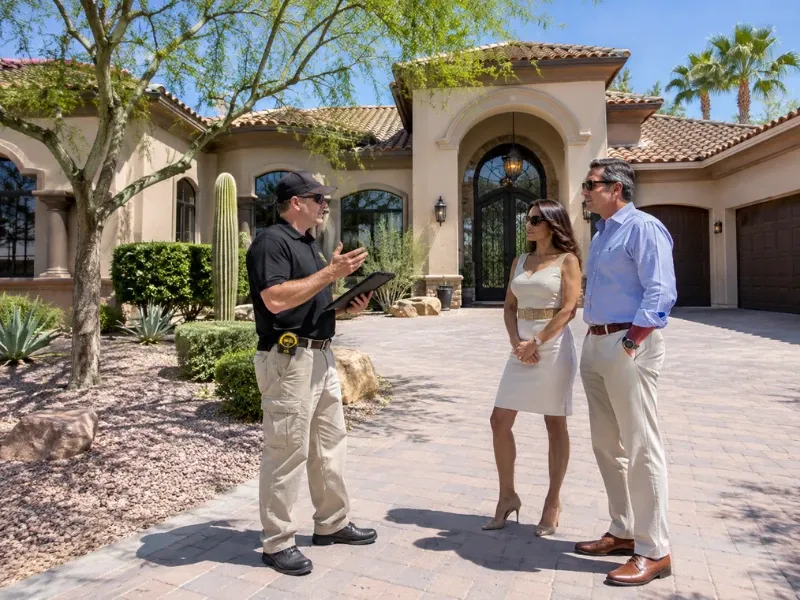
How Do You Plan A Luxury Home Inspection In Chandler?
You plan a luxury home inspection in Chandler by agreeing the full scope in writing, lining up specialists for excluded systems and getting every building ready before the day. Big homes simply have more of everything, so the planning matters more. Halcomb Property Inspections works through that plan with you before inspection day, so nothing gets missed.
By Alex & Jeff, Certified Home Inspector · Last updated November 2, 2026
Which high-end systems fall outside an estate home inspection?
Several systems common in high-end Chandler homes fall outside a standard estate home inspection, because Arizona's rules simply don't require inspectors to look at them. Knowing the list early lets you book the right specialist in time.
Every Arizona inspector follows the Standards of Professional Practice for Arizona Home Inspectors. Beyond the obvious extras, those standards also leave out these items:
Feature | Required under the Arizona standard? | Who usually checks it instead |
Water softeners and RO systems | No, water conditioning is excluded | A water treatment company |
Fire sprinklers and lawn irrigation | No, sprinkler systems are excluded | A fire protection or irrigation contractor |
Smart home, security and audio-video | No, low-voltage systems are excluded | The system installer or a low-voltage technician |
Zone dampers on multi-zone HVAC | No, damper and zone function isn't required | An HVAC technician |
Outdoor fireplaces and fire features | No, if they sit outside the home | A gas fitter or fireplace specialist |
Seals between dual-pane glass | No, coatings and seals are excluded | A window and glass company |
In other words, a home full of premium systems can pass through an inspection with several of them never looked at. Because of that, it pays to read the written agreement carefully and note anything you want added or referred out.
How does a large home inspection label each unit in the report?
A good large home inspection report labels every unit by location, such as "AC 2, upstairs west" or "Water heater, casita closet." That way you can match each finding to the right piece of equipment later.
People asking what is different about inspecting a large home often picture a longer checklist. In practice, careful labeling is one of the bigger changes, because big homes rarely have one of anything. Here's what usually gets its own entry:
Each AC condenser and air handler, with the data plate photographed so you can see the model and manufacture date.
Each water heater, plus any recirculation pump on long pipe runs.
Each electrical subpanel, in the garage, casita or pool equipment area.
Each attic space, since separate hatches often lead to separate sections.
Each roof area, including flat sections behind parapets.
The data plate photos are worth their weight in gold. Arizona's standard doesn't require inspectors to predict how long equipment will last. Even so, a manufacture date tells you which of three AC units is the oldest, so you can plan for it.
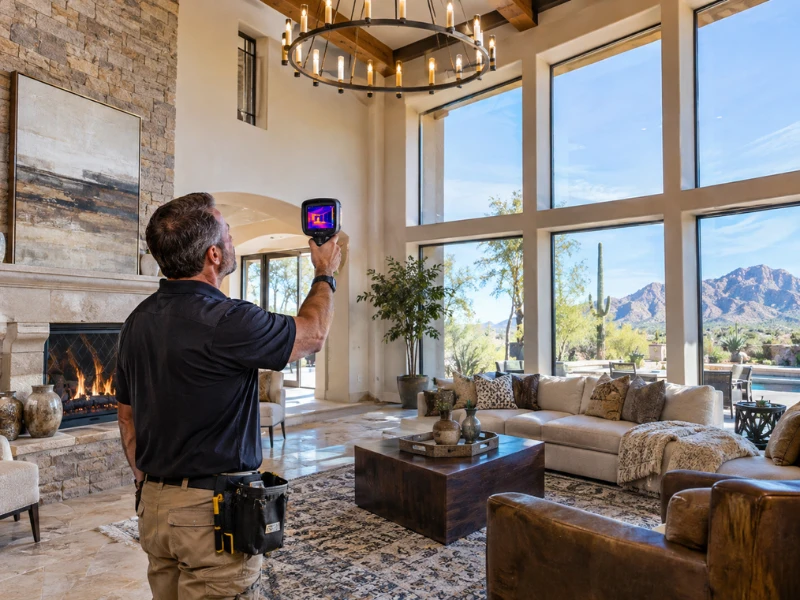
Size also affects routine checks. For example, the standard asks for a representative number of windows, meaning one per room. On a 6,000-square-foot home with 30 rooms, that adds up fast. We also bring thermal imaging and moisture meters to every inspection, which help on large ceilings and roofs where a slow leak can hide.
How do you prep a multiple system property for inspection day?
A multiple system property needs every building open, powered and reachable before the inspector arrives. Otherwise, part of the scope gets written up as "not inspected," and that can leave gaps in your report.
Here's what to sort out with the listing agent ahead of time:
Utilities on in every building, including gas to the casita and power to the pool equipment.
Keys or codes for the casita, detached garage, storage rooms and any gated side yards.
Clear access to attic hatches, which in Chandler often sit above stored boxes in garage cabinets.
Pool and spa running normally, so equipment can be tested under its usual controls.
A list of the systems, such as the number of AC units, whether the solar is owned or leased, and any wells or septic.
Two questions come up before almost every booking: how long does a luxury home inspection take, and how much does a large home inspection cost? Both depend on that same list, which is why we ask for it up front. Our guides to how long a home inspection takes and home inspection costs in Arizona explain the basics in more depth.
Where do we inspect large and estate homes around Chandler?
We inspect large and estate homes across Chandler, Sun Lakes, Gilbert, Queen Creek and Mesa, plus the wider Phoenix metro area. Each part of the area brings its own mix of features.
If you're comparing luxury home inspections in Chandler AZ, here's what tends to come up by neighborhood:
Ocotillo: lakefront and golf homes with large covered patios, outdoor kitchens and big glass walls facing the water.
Southeast Chandler: acre lots along roads like Chandler Heights Road, often with RV garages, casitas, barns and arenas.
Sun Lakes: golf course homes in the 55+ communities south of Chandler, where older systems and later additions are common.
Searching for estate home inspectors near Chandler and Sun Lakes Arizona? Then look for one who scopes the whole lot, not just the main house. Similarly, anyone looking at large property inspectors Chandler AZ should ask how many acre-lot properties the inspector has worked on before. Our Chandler home inspection page covers the standard service area in more detail.
How should you read a long report on a large property?
Read it by building first, then by urgency. A large property report can run from 50 to 100 pages. Sorting it this way keeps the expensive items from getting lost.
Start with anything marked as needing immediate major repair. The Arizona standard uses that term for a defect likely to get worse, cause more damage or create a safety hazard. Next, pull out the items that multiply with size. A tired roof underlayment over 6,000 square feet of tile costs far more than on a starter home. So does a third AC unit near the end of its life.
Then use the rest of your inspection period well. As the Arizona Board of Technical Registration explains, home inspectors generally aren't licensed contractors, so reports often refer items to one. If yours recommends a roofer, HVAC technician or solar contractor, book them straight away. That way you're negotiating with real numbers rather than guesses.
Frequently asked questions
1. What makes a large home different to assess?
Mostly scale and variety, because a large home has more of every system plus features a standard house doesn't have. High ceilings in great rooms and two-story entries can put fixtures out of safe reach. So we note anything we can't access. Long pipe runs can also hide low pressure at the farthest bathroom. That's why we test fixtures at the ends of the house, not just near the water heater.
2. How long does a home over 5,000 square feet take?
Plan on most of the day, usually around five to six hours on site for the main house alone. A common rule is to add about 30 minutes for every 500 square feet past 2,000. A pool inspection then adds roughly 45 to 60 minutes. A casita adds more time again. You'll still get the full digital report within 24 hours, and often the same day.
3. How are casitas, guest houses and outbuildings handled?
A casita or guest house is inspected as its own small home once it's added to your agreement. That covers its roof, electrical panel, plumbing, water heater and cooling, along with the same interior checks as the main house. Barns, sheds, ramadas and shade structures aren't part of a standard home inspection. For those, we'll point out what we can see and recommend a contractor where it makes sense.
4. Are pool, spa and solar systems included or booked separately?
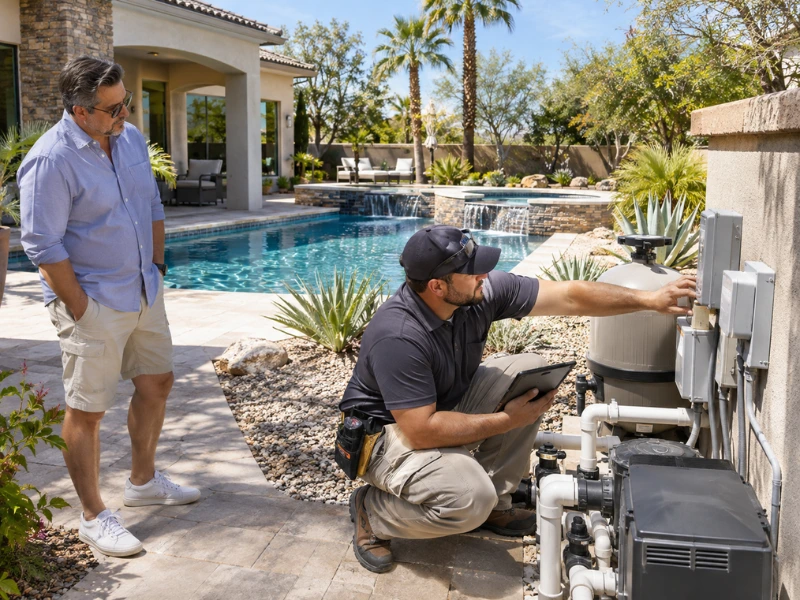
The pool and spa are booked separately as a dedicated pool inspection, which follows Arizona's own pool and spa standards. That covers the pump, filter, heater, surfaces and barrier. Solar isn't inspected as a system, although the panels' mounts and roof penetrations are checked as part of the roof. If the system is leased, ask the seller for the lease early, because transferring it can take a few weeks.
5. How is pricing worked out on larger properties?
Pricing starts with the total square footage, then adds each extra building and any add-on service. So a quote for a 5,500-square-foot home with a casita and pool combines three pieces: the main house, the casita and the pool inspection. Termite inspections are priced on top if you need one. To get an accurate number, tell us the square footage of every building and the add-ons you want when you call.
Visit or Call Us
Halcomb Property Inspections
Phone: (480) 273-9328 (call or text)
Hours: Monday to Sunday, 6:00 AM to 9:00 PM
Veteran-operated home inspection company with InterNACHI-certified inspectors licensed in Arizona, serving Chandler, Sun Lakes, Gilbert, Queen Creek, Mesa and the Phoenix metro area.
