What Does A Property Inspection Find In Chandler Homes?
A property inspection on a Chandler home built in the 1990s or 2000s usually finds a house entering its first big replacement cycle. The structure is usually sound. However, the original equipment, the roof underlayment and the plumbing tend to wear out together, and Halcomb Property Inspections reports on each one so you can budget before you buy.
By Alex & Jeff, Certified Home Inspector · Last updated November 24, 2026
Why do homes built in the nineties and two-thousands need their own checklist?
They were built fast, in large batches and to the same specs. So the same weak points repeat from house to house. Chandler and Gilbert grew enormously during those two decades. As a result, whole neighborhoods share the same roof assembly, plumbing type and equipment brands.
That's useful for buyers. In fact, once we know the builder and the year, we already know where to look harder. Most of our property assessments for Chandler AZ tract homes start with a quick check of which era-specific materials the house still has:
Material | Common in | What the inspection looks for |
|---|---|---|
Polybutylene supply pipe | Homes plumbed through the mid-1990s | Gray plastic lines at the water heater and under sinks, plus crimp-ring fittings |
Kitec (PEX-AL-PEX) pipe | Roughly 1995 to 2007 | Orange or blue pipe with brass fittings showing white or green corrosion |
30-pound felt under concrete tile | Most tract roofs of the era | Brittle, torn or exposed felt at slipped or broken tiles |
R-22 air conditioning | Units installed before 2010 | The refrigerant label on the condenser, since R-22 is no longer produced |
Tank water heater in the garage | Nearly every tract floor plan | Age, rust at the base, scale and the relief-valve drain line |
None of these is an automatic deal-breaker. Still, each one changes what the next few years of ownership will cost, so it belongs in your report.
What does Chandler's hard water do to plumbing and water heaters?
It leaves mineral scale everywhere water flows, and that shortens the life of anything that heats or holds water. According to the City of Chandler, hardness across the city averages 16.5 grains per gallon. That's well into the hard range.
The city also suggests flushing a water heater once a year if the home has a softener and every six months if it doesn't. Few owners actually do that. So during an inspection we check the tank for sediment and rust. We also confirm the relief valve and its drain line are intact, and look for scale crusting the fittings on top.
Elsewhere, scale shows up as white crust on faucets and shower heads. It also leaves stiff shutoff valves under sinks. We also check whether the softener is actually running. Then we confirm its drain is properly separated from the sewer line.
Buying a 20-to-30-year-old home in Chandler?
Call or text: (480) 273-9328
Hours: Mon - Sun, 6:00 AM to 9:00 PM
Offer: Free estimate, with your report usually within 24 hours
See what's included in our residential property inspections.
Why can a tile roof look fine while it's failing underneath?
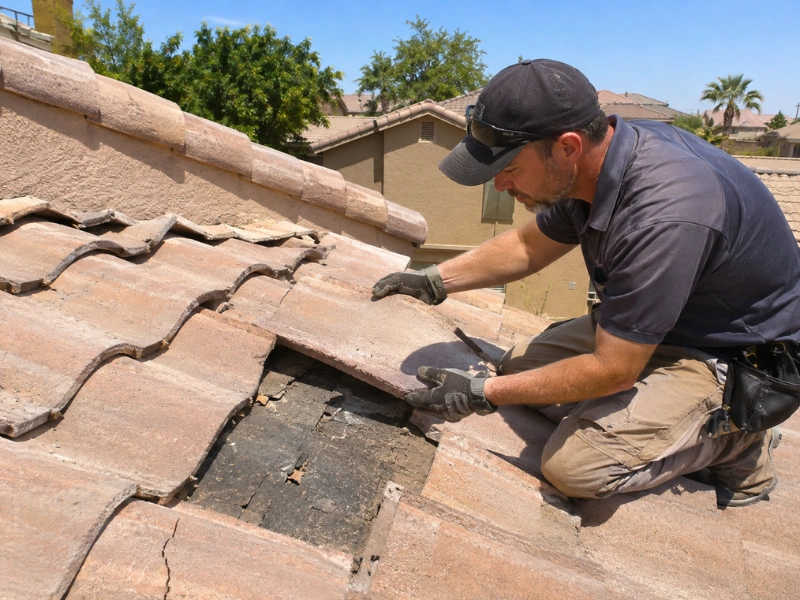
Because the tile is mostly a sunshade, not the waterproofing. The real protection is the felt or synthetic underlayment beneath it, and in a desert attic that layer bakes for decades.
From the street, a 25-year-old concrete tile roof can look nearly new. Up close, however, slipped or cracked tiles often expose felt that has dried out, curled or split along the battens. Valleys, roof-to-wall flashing and the area around rooftop vents are where we usually find the first trouble.
The attic tells the rest of the story. Water stains on the roof deck and rusted nail tips point to leaks. Often, those leaks only show up during monsoon storms. That's why we check both sides of the roof, not just the surface.
How does a property inspection test an AC that's been running since 2005?
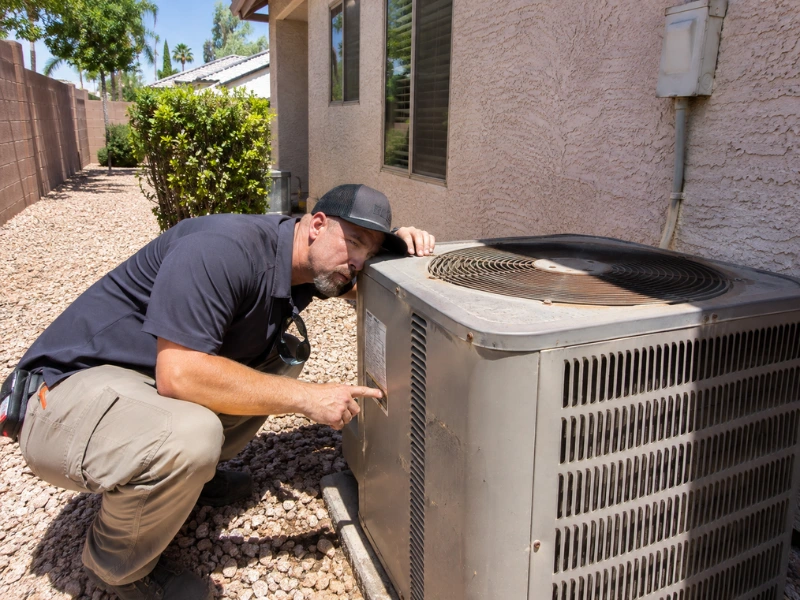
We run it, measure it and read its history from the equipment itself. A property inspection can't predict the exact day a system will quit. Even so, it can show how hard the unit is working and what it's likely to need.
Here's what we look at on an older system:
The data plate, for the manufacture date and refrigerant type
Temperature split, the difference between return air and supply air
The condensate line, which often clogs and drips into a ceiling
Attic ductwork, for crushed runs and loose or torn connections
The condenser coil and fan, for corrosion, damage and noise
On homes that still have R-22 units, we point that out clearly. After all, recharging those systems gets pricier every year. That changes whether repair or replacement makes more sense.
What does a desert yard do to the foundation and the walls?
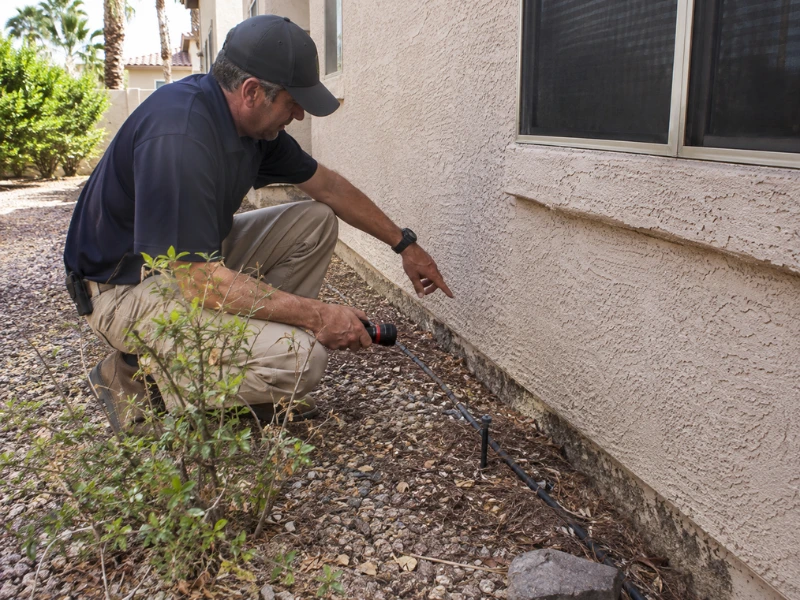
Mostly, it sends water toward the slab. Many tract lots were graded flat, and over 25 years, owners add irrigation, planters and pavers right against the house. Each of those can hold water at the foundation, especially when the downspouts drain straight onto the soil.
During the walk-around, we check that the ground slopes away from the walls and that drip emitters aren't soaking the stem wall. We also look for soil piled above the weep screed at the base of the stucco. That hides moisture and gives termites an easy path in.
Termites deserve their own look in this area. Mud tubes on the stem wall, in the garage or along the attic framing are common findings in the Southeast Valley. If you want a dedicated check, our pest inspections cover subterranean and drywood termites.
Where do we inspect in Chandler, Gilbert and the Southeast Valley?
We cover the whole Southeast Valley, seven days a week. That includes Chandler neighborhoods like Ocotillo and Fulton Ranch, along with Val Vista Lakes and Power Ranch in Gilbert.
Searching for home assessments near Chandler and Gilbert AZ? We also work in Mesa, Tempe and San Tan Valley.
Every inspection follows the Arizona standards for home inspectors. As the Arizona Board of Technical Registration explains, a home inspection is a visual evaluation of conditions on the day it's done. In other words, it's a snapshot, and we'll tell you when something needs a specialist to look deeper.
Frequently asked questions
1. A house built in 1998 - what is reaching the end of its life right now?
Most of the original equipment is at or past its typical life, including the AC, the water heater, the felt under a tile roof and many plumbing fittings. Buyers searching what reaches end of life at twenty-five years, or when do air conditioning units need replacing in Arizona, should know that desert AC units often last around 15 years, so a 1998 home is usually on its second system.
2. Which systems in a desert tract home go first, and in what order?
The water heater usually goes first, followed by the AC, then the roof underlayment, with original plumbing fittings close behind. That's the common pattern for what fails first in a 1990s or 2000s Chandler home, and for anyone searching how long does a roof last in Arizona, the concrete tile can outlast the house while the felt underneath often wears out at 20 to 25 years.
3. What is still original from the builder, and does that matter?
Windows, garage doors, interior doors, faucets, light fixtures and sometimes the ductwork are often still original at this age. Builder-grade originals were chosen for price rather than durability, so they're the parts most likely to need replacing in the next few years.
4. Does a newer house really need looking at as carefully as an old one?
Yes, because a newer house still carries installation mistakes, and after 20 or 30 years those mistakes have had time to cause damage. Many problems in these homes trace back to how they were built rather than simply how old they are.
5. Which findings at this age are normal wear and which are a problem?
Hairline stucco cracks, faded tile, light scale at faucets and worn weatherstripping are normal wear, while active leaks, widening cracks, scorched wiring and an AC that can't hold temperature are real problems. For people searching what goes wrong in a twenty five year old house, the dividing line is simple: wear is cosmetic or slow, and a problem involves water, safety or a system that no longer does its job.
Visit or Call Us
Halcomb Property Inspections
Address: Serving the Phoenix metropolitan area (no storefront)
Phone: (480) 273-9328
Hours: Mon - Sun, 6:00 AM to 9:00 PM
InterNACHI-certified inspectors, licensed and insured in Arizona.
Serving Chandler, Gilbert, Mesa, Tempe, San Tan Valley, Phoenix and Scottsdale. Call for a free estimate, or use our contact page to book an inspection.
