What Is a Seller's Home Inspection in Scottsdale AZ?
Halcomb Property Inspections provides professional sellers home inspection Scottsdale homeowners need before listing — a dedicated pre listing inspection, seller pre sale inspection, and presale home inspection service that identifies issues before buyers find them, supports accurate disclosure, and reduces the chance of deal-killing surprises at the inspection contingency. InterNACHI-certified, licensed in Arizona, written reports within 24 hours.
By Halcomb Property Inspections | InterNACHI-Certified · Last updated July 2026
What Is a Seller's Home Inspection?
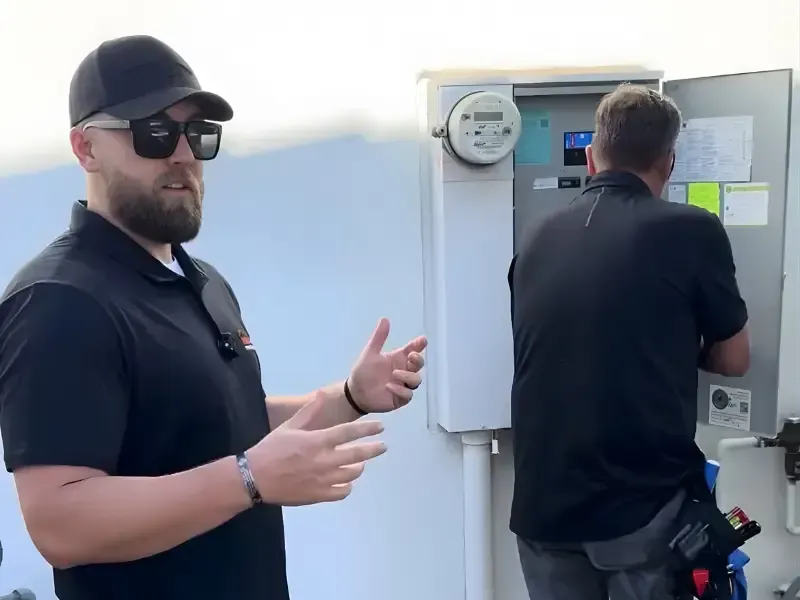
A seller's home inspection — also called a pre-listing inspection or presale home inspection — is a professional assessment of a home's condition ordered by the seller before the property goes on the market. It covers the same scope as a standard buyer's inspection: structure, roof, foundation, HVAC, electrical, plumbing, and interior systems.
What distinguishes it is timing and purpose. Instead of discovering issues during the buyer's inspection — mid-contract, under deadline pressure, with a motivated buyer potentially walking away — a seller's inspection surfaces them in advance, on the seller's schedule, when there's time to address, price-in, or disclose them deliberately.
In Scottsdale's active resale market, a pre-listing inspection is increasingly common among sellers who want to control the narrative of their transaction rather than react to whatever a buyer's inspector finds.
Why Should Sellers Get a Pre-Listing Inspection in Scottsdale?
This is the question worth answering directly — and why should sellers get a pre listing inspection is something the best seller's home inspectors in Scottsdale answer honestly, including the cases where it may not be necessary. Halcomb Property Inspections is licensed under the Arizona Board of Technical Registration — our findings carry the weight of a licensed professional assessment, which matters when the findings inform your disclosure and pricing strategy.
Reason 1: Scottsdale buyers are represented by thorough agents. Scottsdale's buyer pool — particularly in North Scottsdale, the golf communities, and the luxury resale market — includes experienced buyers with experienced agents who push hard on inspection findings. A seller who doesn't know what's in their home walks into the inspection contingency blind.
Reason 2: HVAC failure is the most common Scottsdale deal-killer. An aging HVAC system that fails inspection in a Scottsdale transaction during the summer months creates immediate pressure — buyers in a climate where air conditioning is a necessity, not a comfort, react differently to a failing HVAC than buyers in a mild-weather market. A seller who knows the HVAC is aging can get a service report, price accordingly, or replace proactively.
Reason 3: Scottsdale's 1980s–2000s housing stock has predictable issues. Most of Scottsdale's single-family resale inventory was built between 1980 and 2005. This construction vintage has well-documented failure patterns — original electrical panels approaching end of useful life, galvanized or early copper plumbing, tile roof underlayment that may need replacement even when tiles look fine. A pre-listing inspection tells you which of these your home has before a buyer's inspector does.
Reason 4: Arizona disclosure obligations. The Arizona Department of Real Estate requires sellers to complete a Seller's Property Disclosure Statement (SPDS) disclosing known material defects. A pre-listing inspection gives you documented knowledge of conditions — and once you have documented knowledge, disclosure becomes clearer. Some sellers prefer not to have that knowledge; see the pros and cons discussion below.
Pros and Cons of a Pre-Listing Inspection in Scottsdale
Here's the honest framework — the pros and cons of a pre listing inspection for Scottsdale sellers:
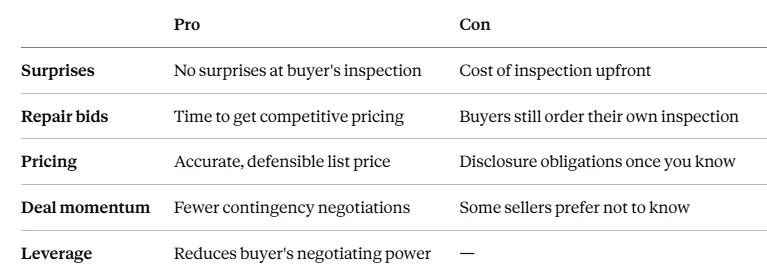
A pre-listing inspection is not automatically right for every Scottsdale seller. What follows is the full breakdown.
Pros:
No surprises at the buyer's inspection. You've already seen what the buyer's inspector will find. You can decide how to handle each item before the contract clock is ticking.
Time to get competitive repair bids. During the contract, sellers are under pressure to accept a buyer's contractor's pricing. Before listing, you can get multiple bids and choose the best option.
Price-in known issues accurately. A home priced accurately for its condition sells faster than one that gets renegotiated down after inspection. A pre-listing inspection supports defensible, informed pricing.
Reduces the buyer's leverage. Findings that a buyer discovers themselves carry more emotional weight than findings already disclosed upfront. A pre-listed repair receipt or a seller's inspection report changes the dynamic.
Supports faster closings. When the buyer's inspection confirms what was already disclosed rather than uncovering surprises, the contingency period moves quickly.
Cons:
Arizona disclosure implications. Once you know about a defect. Some sellers would rather not have documented knowledge of a condition they were planning to sell as-is. This is a legitimate consideration — not a reason to skip the inspection if you're planning to list in good faith, but worth understanding.
Costs money upfront. You pay for the inspection before you know what's in it. If the home is in excellent condition, the inspection confirms what you already expected.
Buyers may still order their own inspection. A pre-listing inspection doesn't eliminate the buyer's inspection — buyers almost always order their own regardless. It informs you in advance; it doesn't replace the buyer's due diligence.
What Does a Seller's Home Inspection Cover?
The seller's home inspection checklist 2026 for Scottsdale properties follows the same scope as a buyer's inspection — the difference is who receives the report and how they use it:
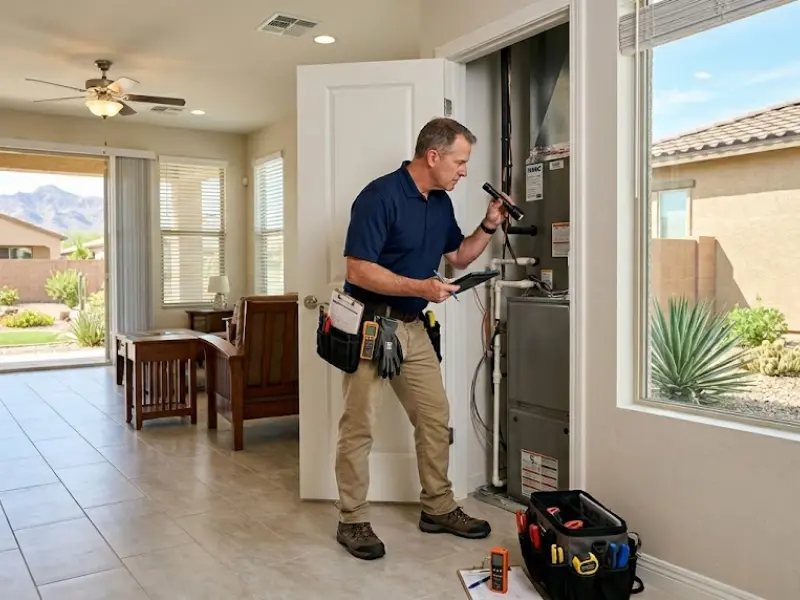
Roof. Tile material condition, underlayment visible at eave edges, flashing at penetrations and valleys. A Scottsdale tile roof that looks fine from the street may have underlayment that's near end of life — this is one of the most common findings in the 1990s–2000s construction stock, and it's worth knowing before listing.
Foundation and slab. Slab condition, cracking patterns, post-tension indicators. Scottsdale's expansive soil creates specific movement patterns — distinguishing cosmetic from structural is part of the assessment.
HVAC systems. Age, condition, condenser status, and capacity relative to home size. This is the highest-priority finding for Scottsdale sellers because of its direct impact on buyer confidence and deal momentum.
Electrical. Panel condition, capacity, visible wiring, and any modifications or additions that may not have been permitted. City of Scottsdale permit records are worth cross-checking for any visible work that might represent unpermitted modifications — a seller who knows about unpermitted work can address it before listing rather than having it surface mid-contract.
Plumbing. Supply and drain lines, water heater condition, and any active or historic leak indicators. Galvanized supply lines in older Scottsdale properties and original ABS drain connections are both conditions worth identifying in advance.
Interior. Walls, ceilings, flooring, windows, and doors. Visible drywall cracking, door misalignment, and floor separation can all be indicators of slab movement worth understanding before listing.
Attic and insulation. Insulation coverage and ventilation adequacy. Scottsdale attics are among the most thermally stressed in the country — gaps that affect cooling performance show up in buyer negotiations.
Pool and spa (where present). Equipment condition, structure, and safety barrier compliance. For Scottsdale properties with pools, a pool inspection is worth bundling — pool condition is a consistent buyer concern and a known negotiating point.
All findings documented with photos in a written report within 24 hours.
Should Sellers Get a Home Inspection Before Listing in Scottsdale?
In most cases, yes — with the caveat that the decision depends on what kind of seller you are and what your goals are for the transaction.
A pre-listing inspection is strongly worth it if:
You've owned the home for more than five years and haven't had recent professional assessments of the major systems
The home was built between 1980 and 2005 — Scottsdale's most common resale vintage — where HVAC, electrical panel, and tile roof underlayment issues are predictable
You're listing in the spring or early summer, when Scottsdale buyers are most active and HVAC performance is most scrutinized
You want the cleanest possible transaction with the least contingency risk
You're in a price range where buyers are represented by aggressive agents who push hard on every inspection finding
You might skip it if:
The home is being sold as-is and priced to reflect condition; the buyer will discover what they discover
You've had recent professional work done on all major systems with documentation
You're selling to a buyer who has already waived the inspection contingency
Even if you skip the pre-listing inspection, Halcomb Property Inspections can conduct a walkthrough consultation — a less formal assessment that gives you a sense of what to expect from the buyer's inspector without a full written report.
How Much Does a Seller's Home Inspection Cost in Scottsdale?
A seller's home inspection is priced similarly to a standard buyer's inspection — cost varies by home size and whether a pool inspection is bundled. Halcomb Property Inspections provides written estimates before scheduling — call (480) 273-9328.
Factors that affect cost:
Square footage — larger North Scottsdale estate homes take longer to inspect thoroughly
Pool or spa presence — bundling pool assessment on the same visit is more economical than scheduling separately
Home age — older homes in the 1970s–1980s South Scottsdale stock sometimes require more time
Multiple HVAC zones — common on larger custom homes; each zone is assessed individually
As the best seller's home inspectors in Scottsdale, Halcomb delivers written reports within 24 hours — giving sellers time to review findings, get repair estimates, and make decisions before the listing goes live.
Do I Have to Disclose a Seller's Home Inspection in Arizona?
This is the most legally sensitive question in this post — and the most important one to understand before ordering a pre-listing inspection.
Under Arizona Department of Real Estate rules and Arizona case law, sellers are required to disclose known material defects through the SPDS. The word "known" is key. Once you commission a professional inspection and receive a written report documenting conditions, you have documented knowledge of those conditions.
What this means in practice:
If the pre-listing inspection finds a defective HVAC unit, you have documented knowledge of a material defect and are required to disclose it
If you choose to repair the defect before listing, you can disclose the prior defect and the repair — which is often a stronger position than undisclosed defects
If you choose to sell without repairing, you disclose the defect and adjust pricing accordingly
You cannot un-know what the report documents; attempting to conceal known material defects creates legal exposure
The report itself: Arizona does not legally require sellers to provide the pre-listing inspection report to buyers. However, your real estate agent's obligations and standard transaction practices in Scottsdale mean that significant findings documented in a pre-listing report are generally disclosed or represented in pricing. Discuss the disclosure strategy with your agent before you commission the inspection.
The straightforward reality: sellers who order a pre-listing inspection in good faith, disclose findings appropriately, and price or repair accordingly have fewer transaction complications than those who don't.
Frequently Asked Questions
1. How much does a seller's home inspection cost in Scottsdale?
Cost varies by home size and whether pool inspection is included. Halcomb Property Inspections provides written estimates before scheduling — call (480) 273-9328. Reports delivered within 24 hours so sellers have time to act before listing.
2. What is a pre-listing home inspection?
A pre-listing home inspection is a professional assessment of a home's condition ordered by the seller before the property goes on the market — the same scope as a buyer's inspection, but conducted on the seller's timeline to identify issues in advance and inform pricing, repairs, and disclosure strategy.
3. Should sellers get a home inspection before listing?
In most cases yes — particularly for Scottsdale homes built between 1980 and 2005, where HVAC, electrical panel, and tile roof underlayment issues are predictable. A pre-listing inspection gives sellers time to address findings proactively rather than reacting under contract pressure.
4. What does a seller's home inspection cover?
Roof, foundation and slab, HVAC systems, electrical, plumbing, interior, attic and insulation, and pool or spa where present — the same scope as a buyer's inspection, documented with photos in a written report within 24 hours.
5. Do I have to disclose a seller's home inspection in Arizona?
You are required to disclose known material defects under the Arizona SPDS framework. Commissioning a pre-listing inspection creates documented knowledge of conditions. You are not legally required to provide the inspection report itself to buyers, but significant findings are generally disclosed or reflected in pricing. Discuss the disclosure strategy with your real estate agent before ordering the inspection.
Schedule Your Seller's Home Inspection in Scottsdale
Whether you're listing next month or planning a listing six months out, Halcomb Property Inspections delivers a thorough seller's assessment with same-day written reports so you have time to act before the market.
Book Your Inspection or call (480) 273-9328 today.
Related services:
Contact Halcomb Property Inspections
Halcomb Property Inspections Phoenix, AZ — Serving all of Maricopa County Phone: (480) 273-9328 Hours: Mon – Sun, 6:00 am – 9:00 pm
Serving Scottsdale, Phoenix, Paradise Valley, Tempe, Mesa, Chandler, Gilbert, and surrounding Maricopa County communities.
