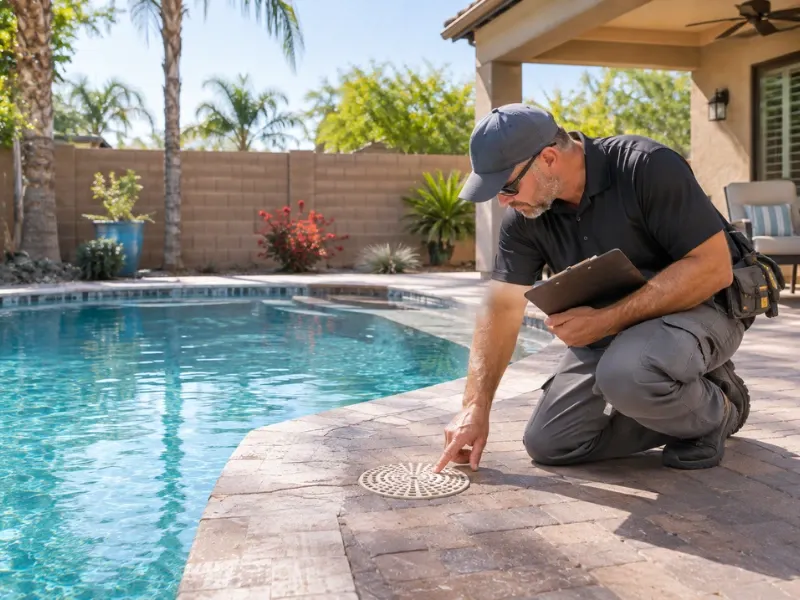
What Does a Swimming Pool Inspection Check in Gilbert?
A swimming pool inspection in Gilbert checks the four things that keep a child out of the water and off the drain. Those are the barrier, the gates and latches, the house doors and windows facing the pool, and the drain covers. Each one gets measured or tested against Gilbert's Land Development Code and Arizona's pool enclosure statute, not judged by eye.
By Alex & Jeff, Certified Home Inspectors · Last updated November 5, 2026
What does a Gilbert pool barrier have to pass?
A Gilbert barrier has to meet two rulebooks at once. The Town sets its own standard in the Land Development Code Section 5.2.7, and Arizona's statute, A.R.S. § 36-1681, fills in the gate and setback details the Town code leaves out.
Use this grid as your checklist. It shows each requirement, where it comes from and how we test it on site:
Barrier item | What the rule says | Source | How we test it |
Fence or wall height | At least 5 feet, no more than 6 feet | Gilbert LDC 5.2.7 | Tape measure on the side away from the pool |
Openings | No gap a 4-inch sphere can pass through | Gilbert LDC 5.2.7 and A.R.S. § 36-1681 | 4-inch gauge at pickets, gate edges and grade |
Gate operation | Self-closing and self-latching | Gilbert LDC 5.2.7 | Release from full open, half open and 12 inches |
Latch height | At least 54 inches above the ground | A.R.S. § 36-1681 | Measure from grade at the gate |
Gate swing | Opens outward, away from the pool | A.R.S. § 36-1681 | Open from the yard side and watch the direction |
Climbable objects | Planters, decks and water features at least 3 feet from the fence | Town of Gilbert policy | Measure every raised item along the run |
Water setback | Barrier at least 20 inches from the water's edge | A.R.S. § 36-1681 | Measure the closest point to the pool |
Double gates | Padlocked whenever not in use | Gilbert LDC 5.2.7 | Check for a working padlock |
Our post on who does pool inspections near me in Gilbert covers the Town code itself in more depth, including the neighbor-fence rule on new pools.
How does an Arizona pool barrier code inspection in Gilbert, AZ work?
It starts outside the barrier, because that's where a child starts. An Arizona pool barrier code inspection Gilbert AZ homeowners can rely on walks the full perimeter, then works inward to the house:
Height from the outside. The Town measures pool fences on the side away from the pool. A wall that reads 5 feet in the yard can read 4 feet 8 inches on the alley side where the grade drops.
View fencing. View panels using wrought iron are common on the Gilbert block walls. Many of the lake lots in Val Vista Lakes and green belts in Power Ranch have these. Because of the state statute requiring horizontal rails no less than 45" apart, having a low rail creates an illegal ladder.
Gaps at grade. Monsoon season causes the pavers to sink and gravel to wash out. A 3" gap under a gate becomes more than 4" after a couple of summers.
Climbables. A built-in BBQ island, a raised planter or a pool equipment enclosure within 3 feet of the fence gives a child a foothold.
Shared walls. Side yards in most Gilbert subdivisions, from Morrison Ranch to Seville, share block walls with neighbors. Each pool owner is responsible for a compliant fence, so a neighbor's lower wall section is still your problem.
The house side. Gilbert's code allows pool owners to use a compliant perimeter fence however, Arizona's statute requires homes with children under the age of 6 to have one of the following on their home side of the fence: 4 foot internal fence, key operated automatic safety cover or self-closing doors with latches 54" or higher from the floor. We test doors, pet doors and windows that open toward the pool, then report which layers are present.
How does a pool fence and self latching gate inspection in Gilbert, AZ test the gate?
The gate gets more testing than anything else on the barrier, because it fails first. A pool fence and self latching gate inspection Gilbert AZ buyers book should include every test below:
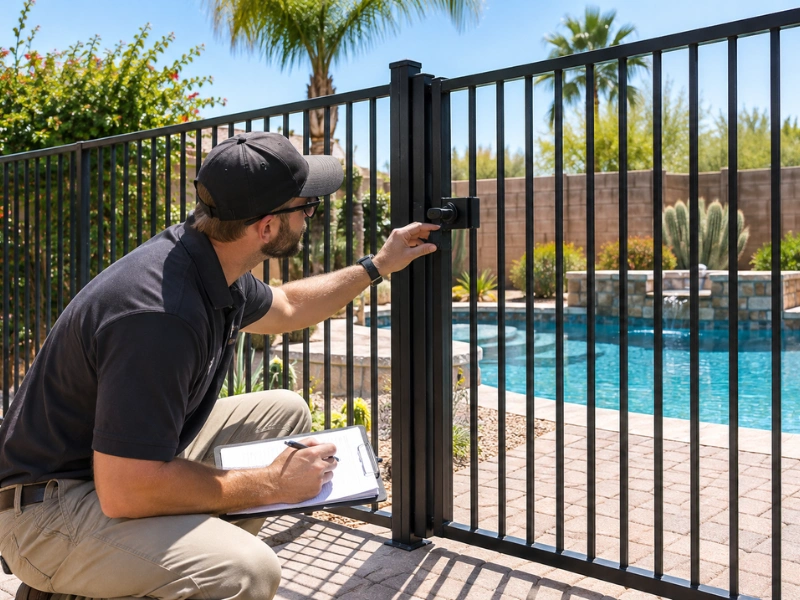
Three release points. We let the gate go from fully open, from half open and from about 12 inches. It has to close and latch from all three without a push.
Latch catch. The latch has to engage every time, not most of the time. A latch that bounces off the strike plate fails.
Latch height. We measure from the ground under the gate, not from the top of a step or paver.
Pool-side release. If the release sits on the pool side, the statute places it at least 5 inches below the top of the gate, with no opening larger than half an inch within 24 inches of it.
Hinge tension. Summer heat and sun wear out spring hinges. A gate that closed briskly at final inspection drifts shut and stops short a few years later.
Sag and drag. A sagging gate scrapes the ground or catches the post, and then it stays open.
Gate height. Gilbert requires gates to be substantially the same height as the fence around them.
Why heat matters here. Steel gates on west-facing walls expand in the afternoon. So a gate that latches at 8 a.m. can stick at 4 p.m., and it's worth testing yours in the afternoon heat too.
What does the drain and safety equipment check cover?
It covers the suction outlets in the pool and spa, plus the equipment that backs up the barrier. A drain cover failure is the other way a pool kills, and it happens under the water where nobody looks.
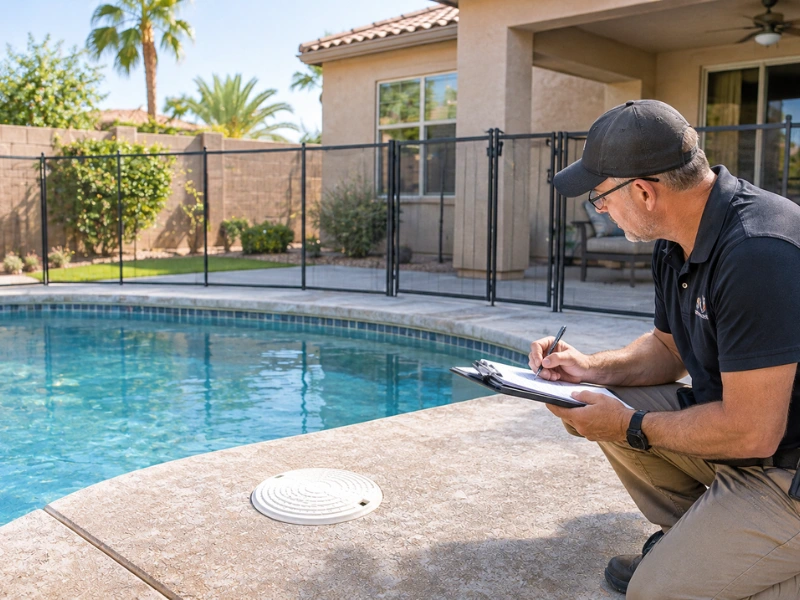
Drain covers. Federal rules under the Virginia Graeme Baker Pool and Spa Safety Act require new drain covers to meet the ANSI/APSP/ICC-16 2017 standard. We check each cover for these points:
Label. The CPSC's Pool Safely drain safety guidance lists the markings to look for, including "VGB 2008," the ANSI/ASME A112.19.8 standard and a swimmer logo.
Shape. Compliant covers are domed, so a body can't seal them flat. Old flat grates are a red flag.
Condition. Sun and chlorine make plastic brittle. Cracked, loose or missing covers mean nobody swims until they're replaced.
Screws. Every screw has to be in place and tight.
Service life. Current covers carry an installation date and a rated life. An expired cover still looks fine in the water.
Other safety items. We also check door and gate alarms, safety covers, GFCI protection on pool lights and receptacles, and equipment bonding.
When does a pool safety compliance inspection in Gilbert, Arizona make sense?
It makes sense any time the barrier or the household changes. A pool safety compliance inspection Gilbert Arizona families book at those points catches problems before a child does.
Book one at these moments:
Before you close on a home. Add it to your home buyer inspection in Gilbert, inside your inspection period.
Before a new pool's final inspection. Gilbert's own policy holds a new pool's final until the barrier passes. Our new construction inspections in Gilbert catch builder misses first.
After fence, wall or landscape work. A new planter, a replaced gate or a regraded side yard changes compliance.
When young children move in or visit. The statute's house-side protections are written for homes with children under six, and visiting grandchildren face the same risk even where the law doesn't require them.
Before renting the home. Arizona's statute requires landlords and sellers to give tenants and buyers the state's pool safety notice.
Our full pool inspections service adds the equipment, surfaces and leak signs to this safety check.
Where is the cheaper fix the worse buy?
Some barrier shortcuts cost less today and fail the next test. These are the ones we see most:
A zip tie or bungee on the gate. It holds a gate shut, but it doesn't self-close or self-latch. It fails inspection and depends on someone remembering it.
A budget latch kit. Cheap gravity latches warp in Arizona sun and stop catching. A magnetic safety latch rated for pool gates costs more and keeps working.
Lowering the latch for convenience. A latch at 48 inches is easier to reach. It's also easier for a 5-year-old to reach.
Reusing an old drain cover. A replacement cover is a small part. Leaving an expired or unlabeled cover in place risks the one injury a pool owner can't take back.
Where cheaper wins. Adjusting hinge tension or re-hanging a sagging gate fixes most gate failures. That's a small repair, not a new fence.
Which red flags mean a barrier won't pass?
Watch for these before an inspector arrives:
A gate that stays open when you let go of it from any position.
A latch below 54 inches measured from the ground.
A planter, BBQ island or spa step within 3 feet of the fence.
A gap under the gate that a soda can rolls through.
A pet door in a house wall that opens straight onto the pool deck.
A flat, cracked or unlabeled drain cover.
Book a swimming pool inspection in Gilbert when you see one. We also cover Chandler, Mesa and Queen Creek.
Frequently asked questions
1. What does Arizona law require for a pool barrier?
Arizona's statute requires a barrier at least 5 feet high, with no opening a 4-inch sphere can pass through and no footholds on the outside. It also sets the barrier at least 20 inches from the water. The pool fence requirements in Gilbert AZ go further, with a 6-foot maximum height and a 3-foot clearance from climbable objects.
2. What height and latching does my gate need?
Your gate needs to match the fence height and carry its latch at least 54 inches above the ground. So yes, a pool fence does have to be a certain height in Arizona: at least 5 feet. Your pool gate does have to self close and latch in Arizona, and it has to open outward, away from the pool.
3. Is my drain cover VGB compliant?
Domed anti entrapment drain covers are compliant if it has passed testing according to the Federal standard. It should be stamped with VGB 2008, ANSI/ASME A112.19.8 or ANSI/APSP/ICC-16, installation date and service life rating. Any flat, cracked, unmarked or out of date drain cover will need replacing before anyone uses the pool.
4. Does my insurer or HOA require a safety inspection?
There is no requirement under Arizona Law that your insurer or HOA will require a safety inspection. Some insurers will ask how you have secured your barrier but there is no substitute for the Town's code. Many HOA's have regulations about what type of fencing you can use and the colours you can use. The most straightforward way to prove you are compliant is to have a report.
5. What happens if my pool fails a barrier inspection?
The report will list all the items that failed with a photograph and measurements. Most of the time this will be related to gates not having compliant hinges and/or latches or something to climb. These can usually be repaired within a day. If an owner receives a citation for violating the statute under Arizona, they will not receive a fine if they install a compliant barrier within 45 days and complete an approved pool safety course.
Visit or Call Us
Halcomb Property Inspections
Address: Mobile inspection service across the Phoenix metro
Phone: (480) 273-9328
Email: Message us through our online contact form
InterNACHI-certified, Arizona-licensed home and pool inspectors
Serving Gilbert, Chandler, Mesa, Scottsdale, Tempe, San Tan Valley and the wider Phoenix metro. Call for a quote, or use our contact page to book an inspection.
