What Does A Building Inspection Cover On Hillside Lots?
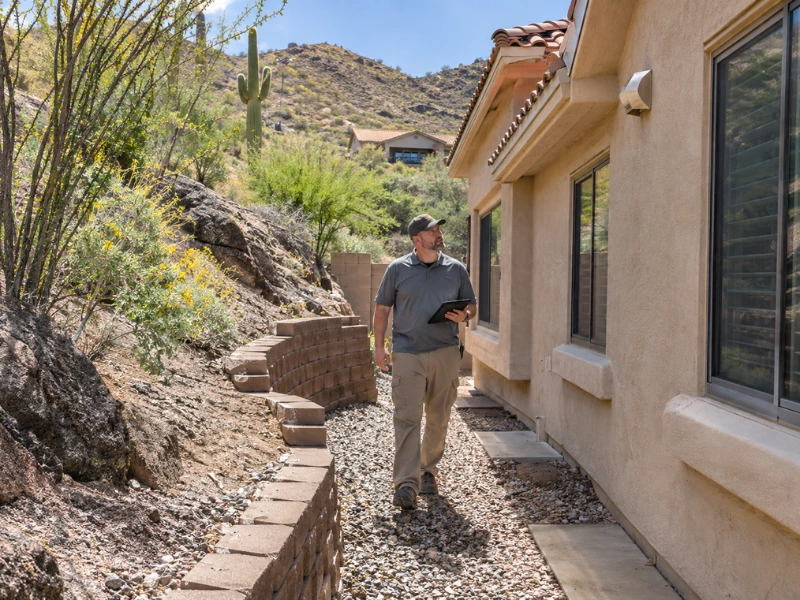
A building inspection on a hillside lot covers the house and the ground it sits on: the walls holding back the slope, the decks and stairs that hang over it, and the native desert pressing up to the edges. At Halcomb Property Inspections, we walk the whole lot in Scottsdale and the north Valley, not just the floor plan, and we flag anything that needs an engineer's eye before you close.
By Alex & Jeff, Certified Home Inspector · Last updated November 23, 2026
Why do hillside and desert lots need a different inspection plan?
Hillside and desert lots need a different plan because the lot itself is doing structural work, so the inspection has to cover far more ground than the house. On a flat lot in central Phoenix, the yard rarely changes the report. On a slope in north Scottsdale, the yard can be half of it.
Part of that comes from the city's own rules. Scottsdale's Environmentally Sensitive Lands Overlay covers about 134 square miles of desert and mountain land north and east of the CAP canal. It requires a share of each property to stay as Natural Area Open Space (NAOS), and on hillside land that share runs from 50% to 80%, depending on slope.
What that means on inspection day:
The house sits on a small pad. Most of the lot stays natural desert, so walls, steps and patios are squeezed into the space around the home.
Native desert runs right to the walls. Boulders, brush and packrat nests can sit a few feet from stucco and equipment pads.
Access is harder. Steep driveways, long site stairs and downhill patios all need checking, and some are only reachable on foot.
That's why we plan more time on these homes. A hillside walk-around takes longer than the interior on some properties, and we'd rather tell you that upfront than rush it.
What does the walk-around cover on a sloped desert property?
The walk-around covers every built feature between the street and the property line, not just the house walls. When buyers ask us what should be checked on a hillside home, this is the part they're usually missing from a standard checklist.
Area | What we look at | When we suggest a specialist |
|---|---|---|
Steep driveway and approach | Cracked or heaved slabs, broken edges, gates and curb transitions | Large sections lifting or breaking away |
Exterior walls and stucco | Crack patterns, patched areas, gaps at windows and doors | Repeated cracks in the same spot after repairs |
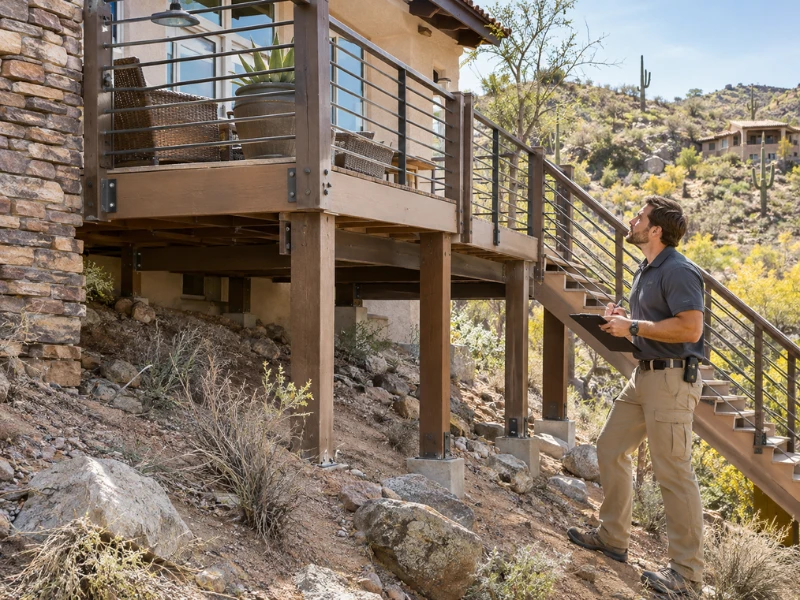
Elevated decks and patios | Posts, beams, ledger connections, railings and stair risers | Any sign the framing or connections are failing |
Site stairs and paths | Uneven risers, loose treads, missing handrails | Steps cut into the slope that are breaking up |
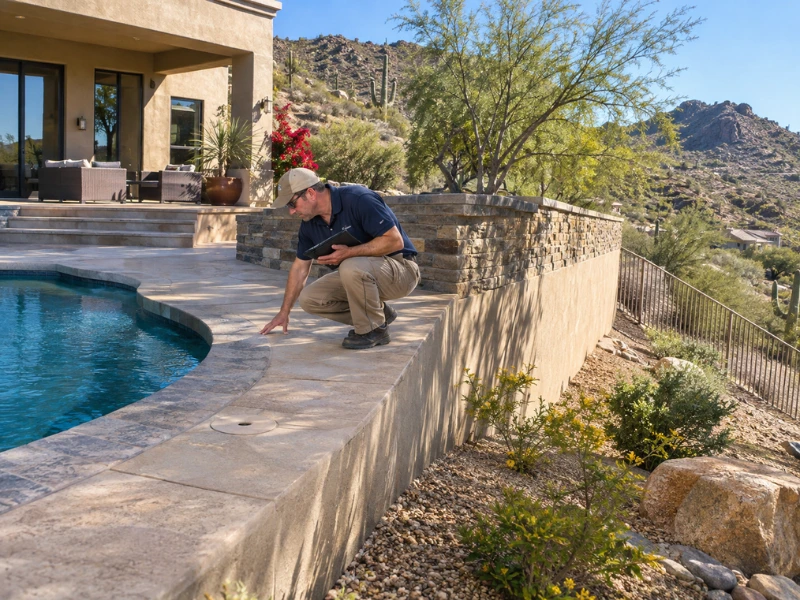
Pool on a slope | Decking, coping, equipment area and the shell edge on the low side | Gaps opening between deck and coping |
Native desert edges | Pest entry points, nesting, brush against the house | Active scorpion or rodent activity |
A pool on a hillside lot deserves its own visit, since the low side carries a lot of weight. Our pool inspections cover the decking, coping and equipment in more detail than a general report can.
The desert edge matters too. Homes backing onto NAOS land see steady pressure from scorpions and packrats, and our guide to pest inspections on desert-edge homes explains what that check adds.
Which retaining and block walls does the inspection look at?
We look at every retaining and block wall we can safely reach, from the tall wall cut into the hillside behind the house to the low garden walls around the patio. They aren't all the same, and the difference matters for your report.
Retaining walls hold back soil. In Scottsdale, the city's walls and fences rules say every retaining wall needs a permit with engineered plans approved by the city.
Dry-stack stone and interlocking block walls need a permit once they're over 30 inches tall.
Privacy and garden block walls mostly hold nothing back, but on a slope they often end up retaining soil anyway, which they weren't built to do.
That last point is where a lot of trouble starts. When clients ask what goes wrong with retaining walls in the desert, the answer usually begins behind the wall, not on its face. Here's what we see most:
Caliche and hard soil that kept builders from digging footings deep enough
Irrigation soaking the backfill, often from drip lines and planters right above the wall
Weep holes packed with debris, so water has nowhere to go
Walls raised over time, with extra courses added years after the original permit
We note the height, type and condition of each wall and whether it appears to be holding back soil. Then you can compare that with the city's permit records before you decide anything.
When does a building inspection call in an engineer?
A building inspection calls in an engineer when a finding needs measurement, calculation or digging that goes beyond a visual check. Home inspectors in Arizona report what they can see. We don't calculate loads or test soil, and we'll say so plainly in the report.
These findings usually lead to a referral:
A wall that supports something. A retaining wall holding up a driveway, pool deck or part of the house carries extra load, and the city treats that seriously.
No permit history for a large wall or addition. If the records don't match what's built, an engineer can tell you whether it was done right.
Decks and patios over the slope. Tall posts and long spans on the downhill side need someone who can check the framing design.
Recent regrading. Fresh fill, new terraces or moved walls near the house can change how the lot behaves, and the change may not show yet.
A referral isn't a verdict. It means the question is bigger than a visual inspection can answer, and you'll want the answer before your inspection period ends.
What should you gather before the inspection?
You'll get more out of the visit if you collect a few documents first. As a result, they help us match what we see on the lot with what was approved.
The seller's disclosure. Arizona's Seller Property Disclosure Statement (SPDS) often notes past wall repairs, grading work or drainage fixes.
Permit history. Ask your agent to pull Scottsdale permit records for walls, additions and pools.
HOA architectural approvals. Many north Scottsdale HOAs keep records of past changes to walls and landscaping.
The plat or site plan. It shows NAOS boundaries, so you'll know which parts of the lot you can actually change.
Also, if you have photos from a past owner or an older listing, bring them too. Comparing a wall today with one from five years ago tells us a lot.
Buying a home on a north Scottsdale slope?
Call or text: (480) 273-9328
Hours: Mon - Sun, 6:00 am - 9:00 pm
Free, no-pressure estimates before you book.
Where do we inspect hillside homes around Scottsdale?
We carry out building assessments in Scottsdale AZ across the city, with much of our hillside work in the north around Troon, Pinnacle Peak, Desert Mountain and DC Ranch. Our Scottsdale inspection page covers the wider service there.
Assessing a hillside home on a north Scottsdale desert lot is a regular job for us, and the same approach carries over to nearby towns with similar terrain. To the east, Fountain Hills has plenty of homes built on cut slopes. To the south, Paradise Valley has estates on the flanks of Camelback and Mummy Mountain.
If you're searching for building assessments near Scottsdale and Cave Creek AZ, call us with the address first. We'll confirm the date and let you know if the lot calls for extra time. For the full list of what a standard visit includes, see our residential property inspections.
Frequently asked questions
1. What does building on a slope change about the structure?
Building on a slope usually means stepped footings and taller stem walls on the downhill side, so the house rests on foundations of different heights instead of one level slab. Those taller walls hold back soil as well as carry the house, which is why we look closely at the downhill corners and at diagonal cracks running from windows and doors.
2. Where does water actually go on this lot in a monsoon?
In a monsoon, water on a hillside lot follows the steepest path, usually down the uphill slope toward the back of the house, around it through side yards or swales, and out to the street or a natural channel. We trace that route by checking grading, roof drain outlets, scuppers and wall openings, since one blocked opening can send the whole flow against the foundation.
3. How do you tell a retaining wall is moving before it fails?
A moving retaining wall usually shows it first as a lean you can see with a level, stair-step cracks in the block, or a joint that is wider at the top than at the bottom. Bowing in the middle of a long run, fresh soil or white mineral staining at the base, and fence posts tilting on top are other early signs worth having an engineer measure.
4. What does a nearby wash mean for the property over time?
A nearby wash means the lot sits beside a natural channel that can run fast and heavy for a few hours after a storm and then stay dry for months, so its banks can shift a little with each big event. Anyone searching for how does a wash affect a property should know that drainage and washes are the two things to keep watching over the years, through bank erosion, the parcel's flood zone status and any drainage easement along the channel.
5. Which of these is expensive to put right, and which is routine?
Routine fixes on a hillside home include clearing scuppers and wall openings, sealing stucco cracks and moving irrigation away from walls and footings. The expensive ones are structural, such as rebuilding or reinforcing a retaining wall, underpinning a settling corner or regrading the lot, which is why those findings come with a referral to an engineer for a firm scope.
Visit or Call Us
Halcomb Property Inspections
Phone: (480) 273-9328
Hours: Mon - Sun, 6:00 am - 9:00 pm
Family- and veteran-operated home inspection company
Serving Scottsdale, Paradise Valley, Fountain Hills, Phoenix, Tempe, Mesa and the wider Valley. Call for a free estimate, or use our contact page to book a visit.
