
Foundation Inspection Near Me in Phoenix: What Homebuyers Need to Know
Halcomb Property Inspections provides home foundation inspection services throughout the Phoenix metro — Scottsdale, Mesa, Chandler, Tempe, Gilbert, and the surrounding Maricopa County communities. If you're searching for foundation inspection near me before buying a home, this guide covers what inspectors evaluate, how to tell if a house has foundation problems, and why Phoenix's soil conditions make foundation review a non-optional part of any home inspection here.
By Halcomb Property Inspections | InterNACHI-Certified · Last updated June 2026
Does a Home Inspection Check the Foundation?
Yes — a standard home inspection includes a visual assessment of the foundation. A licensed home inspector evaluates the visible and accessible portions of the foundation for cracks, movement, settlement, moisture intrusion, and structural concerns. In Arizona, foundation review is among the most important components of any home inspection given the state's expansive clay soil conditions, which cause more foundation movement than in most other regions of the U.S.
What that assessment covers at a standard inspection level:
Slab and stem wall cracks — type, pattern, width, and likely cause (thermal vs. structural vs. soil movement)
Evidence of differential settlement — one section of the foundation moving more than another, which shows in door frames, window openings, and floor surfaces
Visible moisture intrusion or efflorescence (white mineral deposits on concrete that signal water has migrated through)
Drainage and grading around the foundation perimeter — improper grading is a leading cause of accelerated foundation movement in Phoenix homes
Post-tension slab indicators — many Valley homes built after 1985 use post-tension slab construction; inspectors look for signs of tendon failure or slab cracking patterns specific to that system
What a standard home inspection does not include: invasive probing, underground or below-slab investigation, or engineering-level structural analysis. If an inspector identifies conditions that warrant deeper evaluation, the appropriate next step is a referral to a licensed structural engineer — which we note explicitly in our reports when warranted.
Why Foundation Inspection Near Me Matters More in Phoenix
This isn't boilerplate. Phoenix-area homes face foundation risk factors that homebuyers from other regions often don't anticipate.
Expansive clay soil. Much of the Valley sits on expansive clay soil that swells when it absorbs moisture and contracts when it dries out. According to Arizona Foundation Solutions, clay soils absorb water, expand, and put pressure on the foundation — leading to floor cracks, wall cracks, and other structural problems. That repeated expand-contract cycle applies pressure and stress to slab foundations and stem walls season after season.
Monsoon moisture cycling. The Valley gets most of its annual rain in concentrated monsoon bursts — July through September — following months of bone-dry conditions. Clay soil absorbs moisture during the monsoon season and contracts during dry weather. This movement shifts concrete slabs and causes cracking along stress points. In practice, this means a home foundation inspection conducted in May may not tell the full story that a post-monsoon October inspection would reveal.
Irrigation and drainage imbalance. Improper grading, roof runoff concentration, irrigation overspray, and plumbing leaks contribute to soil saturation around the perimeter. In Phoenix's established neighborhoods — from Scottsdale's older subdivisions to Mesa's mid-century blocks — landscaping setups that concentrate irrigation near the foundation are a consistent foundation stress driver. We flag these drainage patterns on every inspection.
Post-tension slab construction. A large portion of Phoenix homes built between the mid-1980s and today use post-tension slabs — concrete reinforced with steel cables under tension. These systems are engineered to handle Arizona's soil movement, but they have their own failure modes: if a tendon fails or if the slab shifts beyond design tolerances, the repair options are more limited and more expensive than on a conventional reinforced slab. Identifying post-tension slab construction and evaluating its visible condition is part of every foundation inspection we perform.
How to Tell If a House Has Foundation Problems: What We See on Phoenix Jobs
Knowing how to tell if house has foundation problems before making an offer can save Phoenix buyers from a costly surprise after closing. The symptoms of foundation movement in Phoenix homes are often visible before any crack appears in the slab itself. Here's how to tell if a house has foundation problems based on what we observe across Maricopa County inspections:
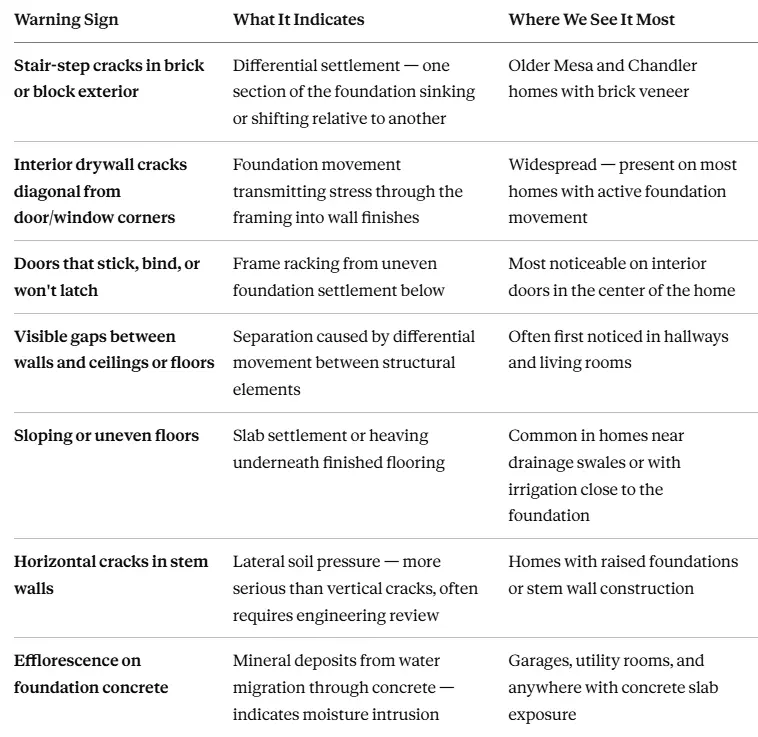
None of these signs are definitive on their own — context matters, and so does the pattern and location of what we find. A single diagonal crack at a door corner in a 30-year-old home with no other signs of movement is different from a home where six of the seven indicators above are present together. That's the judgment call a qualified inspector makes on-site, not from photos.
What a Home Foundation Inspection from Halcomb Includes
When you book a home foundation inspection with Halcomb Property Inspections, foundation evaluation is fully integrated into our comprehensive home inspection — not treated as a quick visual pass at the end.
Foundation assessment: We document visible cracks by location, orientation, and approximate width. We note settlement patterns, efflorescence, moisture staining, and any conditions suggesting active movement versus old, stable cracking. In Phoenix, we also specifically assess drainage and grading conditions around the perimeter, because water management is the primary lever homeowners and buyers have for managing foundation health.
Post-tension slab notation: Where a home has a post-tension slab (most common on homes built after 1985 in Scottsdale, Gilbert, Chandler, and newer Maricopa County developments), we note this in the report and flag any visible tendon-related cracking or slab edge conditions.
Thermal imaging: Our thermal cameras detect temperature differentials that can indicate moisture beneath slab surfaces or behind foundation walls — conditions that wouldn't be visible in a standard walkthrough.
Written report within 24 hours: Every finding is documented with photos, a clear description of what was observed, and a plain-English recommendation — whether that's "monitor and recheck after monsoon season," "consult a licensed structural engineer," or "no concerns noted at this time."
Referral integrity: If we find conditions that exceed what a visual inspection can responsibly assess, we say so clearly and recommend the appropriate specialist. We don't overstate findings, and we don't understate them to avoid complicating a transaction.
Foundation Inspection Guide for Homeowners: When to Get Standalone Foundation Review
This is the practical foundation inspection guide for homeowners trying to decide whether a standard home inspection is sufficient or whether a standalone or specialized foundation evaluation is warranted.
Standard home inspection is sufficient when: The home is under 20 years old, shows no visible cracking, has proper drainage around the perimeter, and is located on a flat lot without known drainage issues. We'll cover the foundation thoroughly as part of the full inspection.
Request a dedicated foundation add-on or structural engineering referral when:
Visible cracks are present at purchase — even if the listing describes them as "cosmetic"
The home is in a neighborhood with known subsidence or drainage issues (parts of older Glendale, South Mountain-adjacent Phoenix, or areas near former agricultural land)
The home has had prior foundation repair — disclosed or suspected
There's a significant slope change or drainage feature on the lot that directs water toward the foundation
Inspection reveals stair-step cracking, horizontal stem wall cracks, or multiple signs of active differential settlement
For pre-purchase buyers, the cost of a thorough foundation inspection is minimal relative to the repair exposure. Foundation inspection identifies the cause of movement through crack mapping, slab evaluation, load path review, and perimeter moisture assessment before repairs begin. Foundation repair in the Phoenix market ranges from a few hundred dollars for minor crack patching to $10,000–$30,000+ for serious slab stabilization work. Finding it before close gives you the ability to renegotiate, request repairs, or walk away.

Frequently Asked Questions
1. Does a home inspection check the foundation?
Yes. A standard home inspection includes a visual assessment of all accessible foundation components — slab, stem walls, perimeter drainage, and visible structural elements. In Phoenix, this includes evaluation of crack patterns, settlement indicators, moisture evidence, and post-tension slab conditions specific to Arizona construction. Halcomb Property Inspections documents all foundation findings with photos in a report delivered within 24 hours.
2. What does a home foundation inspection include?
A home foundation inspection from Halcomb includes: visual documentation of cracks by type and location, assessment of drainage and grading around the foundation perimeter, thermal imaging for hidden moisture, post-tension slab notation where applicable, and a written report with photos and clear recommendations. If findings warrant deeper evaluation, we provide a structural engineer referral directly in the report.
3. How to tell if a house has foundation problems in Phoenix?
The most reliable signs are: stair-step cracks in exterior brick or block, diagonal drywall cracks at door and window corners, doors that stick or won't latch, visible gaps between walls and ceilings, sloping floors, and efflorescence on concrete surfaces. In Phoenix specifically, these signs are often driven by expansive clay soil reacting to seasonal moisture swings. Multiple signs appearing together — especially after a monsoon season — warrant a foundation inspection before purchase.
4. What is a foundation inspection guide for homeowners in Phoenix?
For Phoenix homebuyers, the essential foundation inspection guide covers: (1) always include foundation assessment in your home inspection; (2) look for stair-step cracks, sticking doors, and uneven floors before making an offer; (3) understand that expansive clay soil and monsoon moisture cycling make Phoenix homes more prone to foundation movement than homes in most other markets; (4) request a structural engineer referral if visible cracking or settlement is present; and (5) factor foundation condition into repair estimates before closing.
5. How much does a foundation inspection cost in Phoenix?
A home foundation inspection is included in Halcomb Property Inspections' standard home inspection, which covers the full property. For a standalone or specialty foundation evaluation, pricing depends on the scope and whether thermal imaging or additional documentation is required.
Schedule a Foundation Inspection in Phoenix
Whether you're buying in Chandler, Scottsdale, Mesa, or anywhere in the Phoenix metro, don't skip foundation review — especially on any home over 15 years old or any property showing visible cracking. Halcomb Property Inspections delivers same-week scheduling and reports within 24 hours.
Book Your Inspection or call (480) 273-9328 to schedule.
Also see:
Contact Halcomb Property Inspections
Halcomb Property Inspections Phoenix, AZ — Serving all of Maricopa County Phone: (480) 273-9328 Hours: Mon – Sun, 6:00 am – 9:00 pm
Serving Phoenix, Scottsdale, Mesa, Chandler, Tempe, Gilbert, Glendale, Peoria, Surprise, Anthem, Paradise Valley, and surrounding Maricopa County communities.
