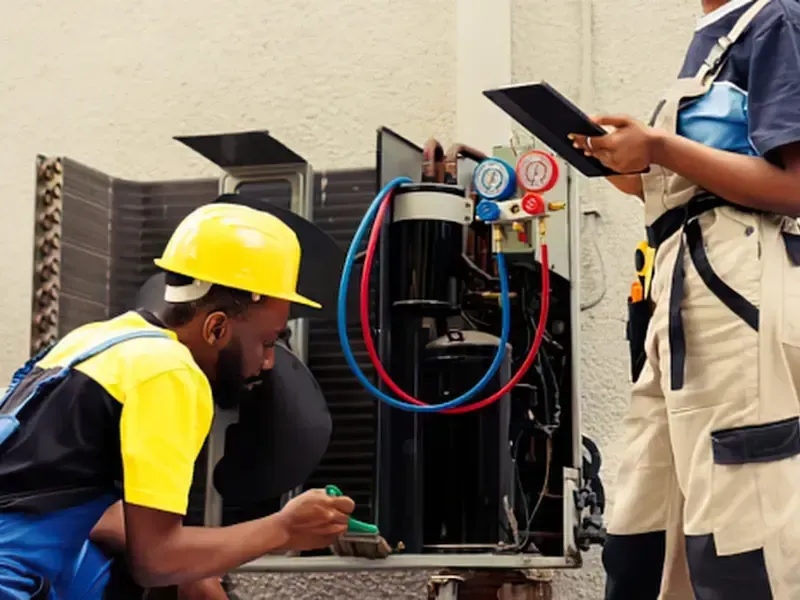
What Does an HVAC Inspection Include in Mesa, AZ?
An HVAC inspection covers what can be observed and operated: system age, condition, airflow, controls, condensate handling, and whether the equipment cools the house. It does not cover refrigerant charge, and there's a federal reason for that rather than a convenience one.
By Alex & Jeff, Certified Home Inspector · Last updated August 12, 2026
What Does an HVAC Inspection Include?
Ask what does an HVAC inspection include and the useful answer is a list of things that can be seen, measured at the register, or switched on.
We check the equipment's age and rated capacity from the data plate, and whether that capacity is plausible for the house. We look at the condenser — coil condition, clearances, whether it's level, whether the disconnect is present and correct. Inside, we look at the air handler or furnace, the filter and its housing, the blower, and the evaporator coil where it's visible. We run the system in cooling and, where applicable, heating, and measure the temperature split between return and supply air, which tells us whether it's actually moving heat.
Then the parts people forget. Ductwork condition and obvious disconnections. Return air sizing, because an undersized return starves a system that's otherwise fine. Condensate drainage and the secondary pan, which in Arizona matters more than in most places since so much equipment sits in attics and garages above finished space. Thermostat operation. And on gas equipment, visible flue and venting condition.
Our residential inspections include this as standard scope, and the broader picture is in our home inspection checklist for buyers.
What It Doesn't Include, and Why?
Refrigerant. This is the question I get asked most, and the answer isn't discretion — it's federal law.
Checking a refrigerant charge means connecting gauges to a sealed system. EPA regulations under Section 608 of the Clean Air Act, at 40 CFR Part 82 Subpart F, require that anyone who maintains, services, repairs, or disposes of equipment that could release refrigerants must hold Section 608 technician certification. EPA puts the threshold plainly in its own program guidance: certification is required for anybody who, in the course of maintenance, service, or repair, could reasonably be expected to violate the integrity of the refrigerant circuit.
Attaching a manifold to a service port does exactly that. So an inspector without 608 certification cannot legally check your charge, and one who offers to should give you pause about what else they're improvising.
What we can do instead is measure the temperature split and look at the symptoms an undercharged system produces — long run times, poor cooling on the hottest afternoons, ice on the suction line, oil staining at a fitting. Those are indicators, not measurements, and the report should say so. If they show up, the next call is a licensed HVAC contractor with a 608-certified technician.
Two other things sit outside scope: disassembling equipment to examine a heat exchanger internally, and predicting how long a working system will keep working. Anyone who tells you a functioning unit has three years left is guessing.

Home Inspector or HVAC Specialist?
Both, in that order, and knowing why saves money.
An inspector operates the system in normal mode, reports condition and performance, and flags what needs specialist attention. That's the right scope for most purchases, and it's what Arizona home inspectors are certified to do under the standards they work to. A specialist opens the system, tests refrigerant, checks combustion, and can service or replace.
Reverse that order and you pay for a service call to learn something an inspection would have told you. Follow it and the specialist arrives knowing what to look at.
Three situations call the specialist in straight away: the system doesn't cool, the equipment is at the end of its life and you need a replacement quote, or an inspection has already flagged a heat exchanger or refrigerant concern. Anyone asking which inspector handles HVAC inspection for home buyers in Mesa is asking the right question — just expect the answer to include a referral rather than a diagnosis. For deeper capacity and remaining-life analysis on the mechanical, electrical, and plumbing systems together, our MEP inspection guide covers that scope.
How Long Does an HVAC System Last in the Arizona Desert?
Shorter than the national figures, and the reason is runtime rather than heat alone.
A system in a mild climate cycles a few months a year. Here it runs hard from April into October, often most of the day, sometimes most of the night. Same equipment, several times the operating hours, so it reaches the same wear in fewer calendar years.

Two Arizona-specific accelerants. Rooftop and attic-mounted equipment cooks in ambient temperatures far above what the rating assumes, and a condenser in full afternoon sun on a west elevation works harder than the identical unit in shade. Shading a condenser without blocking airflow is one of the few genuinely free improvements available.
If your house still has an abandoned evaporative cooler on the roof from before refrigerated air went in, that's worth mentioning when you book. We find them regularly, usually with an unsealed roof penetration and a live circuit nobody has labeled.
Signs Your HVAC Needs Replacement in Mesa
Age matters, but symptoms matter more.
Rising run times with no change in the weather. Rooms that used to cool and no longer do. A system that can hold temperature in June but not in July. Repeated repairs, particularly a second refrigerant leak, since the first one told you the coil or line set is failing. Rising power bills without a rate change. Noise that's new.
Then the one that decides more replacements in this market than any other: refrigerant type. R-22 has been out of production for years, and topping up a leaking R-22 system now means reclaimed refrigerant at a price that makes repair hard to justify. If your data plate says R-22, a significant leak is usually a replacement conversation rather than a repair one. The industry has since moved on from R-410A too, so a very old system sits two generations behind on parts and refrigerant availability.
Our guide to things that fail a home inspection covers how this shows up during a sale.
Cost, Frequency, and Where We Work
How much does an HVAC inspection cost depends on whether it's bundled. Within a full residential inspection it's part of standard scope rather than a separate line. As a standalone visit — usually for an owner who isn't buying or selling, or a landlord checking a rental between tenants — it's shorter and priced accordingly. Multiple systems add time, and a good many Mesa homes have two. A specialist's diagnostic service call is a different product at a different price. Our quotes are free.
On how often should an HVAC system be inspected, the standard advice is twice a year. In Arizona the weighting is uneven: the pre-season check in spring is the one that matters, because a marginal system will survive a mild May and fail in a 112-degree July. Change filters far more often than the packaging suggests, since dust load here is heavy. And get a full assessment at purchase, after any duct or equipment work, and when the system turns twelve.
We cover Mesa and Phoenix, with the full list on our locations page and the buildings we handle on our property types page. An AC inspection Maricopa County AZ homeowners book runs the same way whichever city it's in, and an air conditioning inspection Phoenix metro buyers commission during escrow follows the same scope.
If you've been searching HVAC inspection Mesa AZ, comparing the best HVAC inspectors near Mesa AZ, or the top rated AC inspection companies in the East Valley, ask one question first: will you check refrigerant? Any honest HVAC inspector Arizona homeowners hire will tell you no, and explain why.

Frequently Asked Questions
1. How long does an HVAC inspection take in Arizona?
Thirty to sixty minutes for a single system as part of a full home inspection, which includes running it in cooling, measuring the temperature split, checking the condenser and air handler, and looking at accessible ductwork and condensate handling. Homes with two systems take roughly twice as long. Add time where equipment is in a tight attic, where access is poor, or where the outdoor unit is on a roof.
2. What is the lifespan of an HVAC system in the Arizona desert?
Shorter than national averages, because of runtime rather than heat alone. Condensers and heat pumps typically give 10 to 15 years here against 15 to 20 in milder climates, since they run hard from April into October. Air handlers and furnaces usually outlast the condenser, at 15 to 20 years. Evaporator coils run 10 to 15. Rooftop and attic equipment ages fastest, and a condenser in full west-facing afternoon sun works measurably harder than the same unit in shade.
3. Can a home inspector inspect an HVAC system or do I need a specialist?
Both, in that order. An inspector operates the system in normal mode and reports age, condition, airflow, controls, condensate handling, and whether it actually cools — sufficient for most purchases. A specialist opens the sealed system, tests refrigerant, checks combustion, and can service or replace. Start with the inspection so the specialist arrives knowing what to examine.
4. What are signs my HVAC needs replacement in Mesa?
Longer run times with no weather change, rooms that no longer cool, a system that holds temperature in June but not July, rising power bills without a rate change, new noise, and repeated repairs — especially a second refrigerant leak, which points at a failing coil or line set.
5. Does HVAC inspection include refrigerant levels?
No, and it's a legal limit rather than a choice. Checking a charge requires connecting gauges to the sealed system, and EPA regulations under Section 608 of the Clean Air Act require certification for anyone who could reasonably be expected to violate the integrity of the refrigerant circuit during maintenance, service, or repair. An inspector without that certification cannot legally do it.
Contact Halcomb Property Inspections
Halcomb Property Inspections Serving Mesa, AZ and the Phoenix metropolitan area Phone: (480) 273-9328 Hours: Monday–Sunday, 6:00 AM – 9:00 PM Serving Mesa including Dobson Ranch, Alta Mesa, Eastmark, and Lehi, plus Phoenix and the East Valley.
Buying a house with a system you're unsure about? Request a free quote or call (480) 273-9328, and we'll tell you what the equipment is, how it's performing, and whether it's time to bring in a specialist.
