What Does an HVAC Inspection Cover in Paradise Valley?
Condition, operation and performance — but not capacity, and the difference matters here more than most places. On a large custom home that's been added to over thirty years, the question isn't only whether the equipment works. It's whether it was ever sized for the house as it now stands.
By Alex & Jeff, Certified Home Inspector · Last updated August 27, 2026
What Gets Checked on the Equipment?
What does an HVAC inspection include, on the hardware side, is fairly consistent wherever you are.
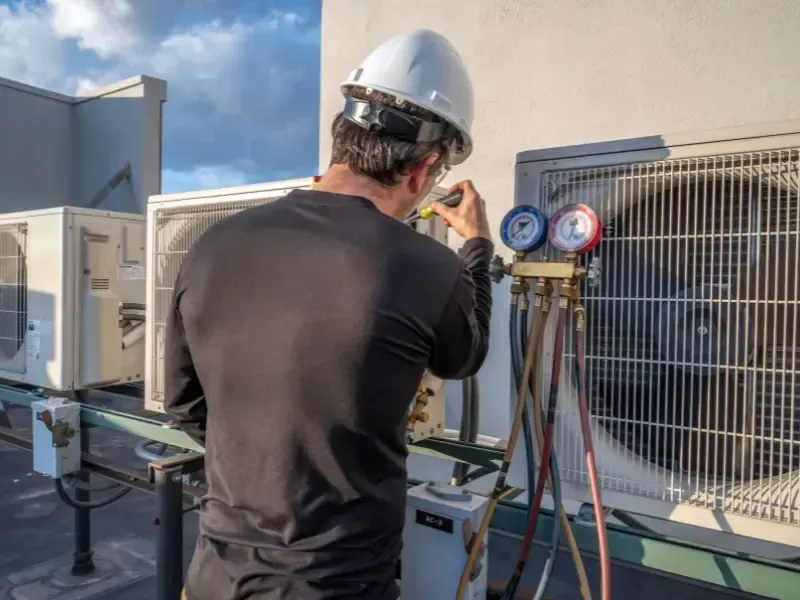
Equipment age and rated capacity from the data plate, and whether that rating is plausible for the space it serves. The condenser: coil condition, clearances, whether it sits level, disconnect present and correct. The air handler or furnace: filter and housing, blower, visible evaporator coil, condensate pan and drain. Then operation — running the system and measuring the temperature difference between return and supply air, which tells you it's genuinely moving heat rather than simply making noise.
After that, the parts people forget. Accessible ductwork and obvious disconnections. Return air sizing. Condensate routing and the secondary pan, which matters here because so much equipment sits in attics above finished ceilings. Thermostat operation. Visible flue and venting on gas equipment.
The refrigerant question — why charge testing sits outside an inspection entirely — is covered in our Mesa HVAC guide, along with the desert lifespan figures.
Why Isn't Performance the Same as Capacity?
Here's the distinction that decides whether an inspection answers your actual question.
Measuring the temperature split tells you the system is performing — heat is moving, the refrigerant circuit is doing something, the blower is delivering air. What it cannot tell you is whether the equipment is correctly sized for the house.
Sizing is determined by a load calculation. The industry standard is ACCA Manual J, which the Department of Energy's Building America duct guidance identifies alongside Manual D for duct design. A Manual J takes the building — orientation, glazing, insulation, infiltration, room by room — and produces the actual cooling and heating load. That's an HVAC contractor's exercise, not an inspector's.
Why it matters in Paradise Valley specifically: these houses get extended. A system sized correctly for the original footprint in 1994 may now be serving an added wing, a converted garage, or a glazed addition nobody recalculated for. The symptom is a system that runs constantly, holds temperature in April and loses it in July, and gets diagnosed as "old" when it's actually undersized for what it was later asked to do.
So when you ask whether we test cooling capacity, the honest answer is no — we measure performance, document what's installed, and tell you when the numbers suggest a load calculation is the next step rather than a replacement quote.
How Much Cooling Do the Ducts Lose?
More than most homeowners would believe, and disproportionately so on large properties.
ENERGY STAR puts typical residential duct losses at 20 to 30 percent of conditioned air. That figure assumes an ordinary house. Now apply it here: long duct runs, often through an attic that reaches well above 150°F on a July afternoon, serving a footprint two or three times the national average.
Two mechanisms are at work. Leakage at joints, takeoffs and plenums, which sends conditioned air into the attic. And conduction, where air travelling through a duct in a superheated space picks up heat before it ever reaches a register. Both worsen with run length, which is why a large single-storey home can have a perfectly healthy condenser and still fail to cool its far bedrooms.
What an air conditioning inspection can establish: whether accessible ductwork is intact, whether insulation is present and undamaged, whether returns are adequately sized, and whether the temperature at distant registers is materially worse than near ones. What it can't produce is a measured leakage figure — that's a duct blaster test, and it's a separate service worth commissioning where the symptoms point that way.
Why Do Large Homes Need Zone-by-Zone Attention?
Because a Paradise Valley property frequently isn't running one system, and the systems aren't the same age.
Two, three, sometimes four separate units is normal on a one-acre lot with a casita and a detached garage or workshop. They're rarely replaced together, so one zone can be five years old and another sixteen. A hvac system inspection here has to treat each as its own assessment rather than sampling one and generalising.
Zoning adds a second layer. Where a single system serves multiple zones through motorised dampers, a damper stuck closed presents exactly like a capacity problem — one area never gets comfortable, the rest is fine. It gets misdiagnosed as an undersized or failing unit with some regularity, and the fix is a fraction of the cost.
So the useful output on a large property is a system-by-system inventory: what serves what, how old each is, how each performed, and which zones responded. Our Paradise Valley home inspection guide covers how that fits into a full inspection on these properties.
What Does the Written Report Give You?
Everything photographed, located and attributed to a specific unit.
That last part is the difference on a multi-system property. "The condenser coil is fouled" is unhelpful when there are three condensers. A report naming the unit, its location, its data plate details and the measured split for each is something you can hand to an HVAC contractor and get a straight quote from, or hand to a seller's agent and negotiate against.
What the report also does is state its limits plainly: which areas weren't accessible, what wasn't tested and why, and where a specialist assessment is warranted. A heating and cooling inspector who reports only findings and never limitations is producing a document that reads well and holds up poorly.
We don't repair. Arizona home inspectors work to a defined observational standard under the State Board of Technical Registration, and repair, load calculation and refrigerant work belong to a licensed HVAC contractor. That separation is what makes the report useful in a negotiation — there's no work at the end of it for us to sell you.
How Much Does It Cost, and How Often?
How much does an HVAC inspection cost in Paradise Valley depends mostly on system count. Inside a full residential inspection, HVAC assessment is standard scope rather than an extra. As a standalone visit it's shorter and priced accordingly — but a property with three systems, a casita and zoning takes roughly three times as long as a single-system house, and pricing follows that. A duct blaster test or a Manual J are separate engagements with separate providers. Estimates are free.
How often should HVAC be inspected in Arizona: annually, weighted toward spring. The pre-season check is the one that matters, because a marginal system will survive a mild May and fail in a 112-degree July, and the queue for repairs in August is long. Beyond that, get a full assessment at purchase, after any duct or equipment work, and when a system passes twelve years.
Change filters far more often than the packaging suggests — dust load here is heavy, and a restricted filter mimics half a dozen more expensive faults.
We cover Paradise Valley, Scottsdale and Phoenix, with scope on our residential inspections page, the buildings we handle on property types, and the area list on our locations page. Recurring findings across the Valley sit in our guide to things that fail a home inspection.
Searching for a hvac inspector Paradise Valley Arizona owners use independently, or comparing hvac inspection near me Paradise Valley AZ? Ask whether the report will name each system separately. An air conditioning inspection near Paradise Valley that treats a three-system house as one system hasn't done the job.

Frequently Asked Questions
1. What does an HVAC inspection cover?
Equipment age and rated capacity from the data plate, condenser coil condition and clearances, the air handler including filter, blower and visible evaporator coil, condensate pan and drain, and operation in cooling with the temperature difference measured between return and supply air. Beyond the equipment: accessible ductwork and insulation, return air sizing, thermostat function, and visible flue and venting on gas appliances. On multi-system properties each unit is assessed separately rather than one being sampled and generalised across the house.
2. How much does an HVAC inspection cost in Paradise Valley?
System count drives it more than anything else. Within a full residential inspection, HVAC assessment is included as standard scope rather than charged separately. As a standalone visit, a single-system house is straightforward while a property with three systems, a casita and zone dampers takes roughly three times as long, and pricing reflects that. Specialist follow-ups are separate engagements: a duct blaster leakage test, or a Manual J load calculation to establish whether equipment is correctly sized.
3. How often should AC be inspected in the desert heat?
Annually, and the timing matters as much as the frequency. Weight it toward spring, because a marginal system will get through a mild May and then fail during a 112-degree July, when repair queues are longest and the failure is least tolerable. Also inspect at purchase, after any duct or equipment work has been carried out, and once a system passes twelve years. Separately, change filters considerably more often than the packaging suggests, since dust load here is heavy and a restricted filter imitates several more expensive faults.
4. Do you test cooling capacity and ductwork?
Not capacity, and partially on ductwork — the distinction is worth understanding. We measure performance by running the system and recording the temperature split, which shows heat is being moved. Capacity means whether the equipment is correctly sized for the house, and that requires an ACCA Manual J load calculation performed by an HVAC contractor. On ducts we assess accessible runs, insulation condition, return sizing, and whether distant registers perform materially worse than near ones. A measured leakage figure requires a duct blaster test, which is a separate service.
5. Do you provide a written HVAC report?
Yes, with every finding photographed, located, and attributed to a specific unit — which matters on a property running three condensers, where a note about "the condenser coil" tells nobody anything useful. Each system gets its data plate details, its measured performance and its own findings, so the report can go straight to an HVAC contractor for a quote or to an agent in a negotiation. It also states its limitations: what wasn't accessible, what wasn't tested, and where specialist assessment is warranted.
Contact Halcomb Property Inspections
Halcomb Property Inspections Serving Paradise Valley, AZ and the Phoenix metropolitan area Phone: (480) 273-9328 Hours: Monday–Sunday, 6:00 AM – 9:00 PM Serving Paradise Valley including the Camelback and Mummy Mountain areas, plus Scottsdale, Phoenix, and the wider Valley.
Rooms that never quite cool? Request a free quote or call (480) 273-9328, and we'll assess each system separately and tell you whether the problem is the equipment, the ducts, or a damper.
