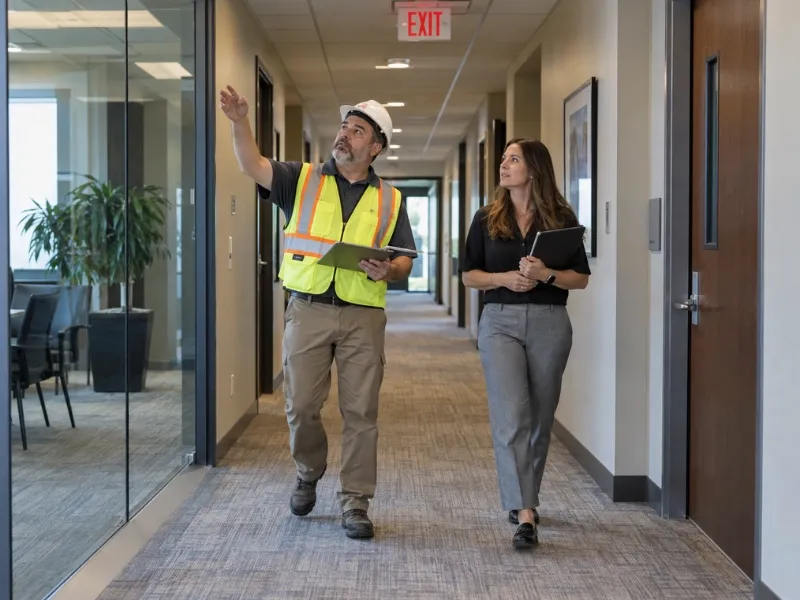
Which Office Building Inspection Fits A Chandler Deal?
The right office building inspection for a Chandler deal covers the roof, rooftop cooling, electrical, plumbing, life safety and accessibility across the common areas and each accessible suite. It then reports each finding by priority and remaining life, so you and your contractors can price the repairs. At Halcomb Property Inspections, we scope each office inspection around the deal, whether you're buying, lending or signing a lease.
By Alex & Jeff, Certified Inspectors · Last updated October 28, 2026
What do office building systems inspections cover?
Every major system that keeps the building open and leasable. Office building systems are larger and more shared than at home.
People who search "what is checked in an office building inspection" expect a long checklist. Here's what matters most in Chandler:
System | What we look at | Why it matters in Chandler |
Roof | Membrane condition, ponding, flashing and every rooftop penetration | Intense sun and summer storms wear low-slope roofs fast |
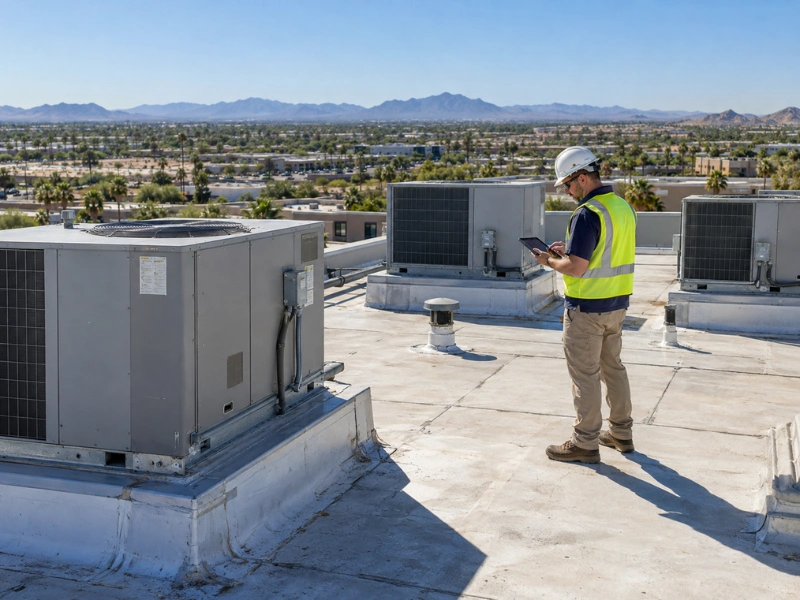
Rooftop HVAC units | Age, condition, condensate drainage and curb connections | Cooling is the biggest operating load here, and units wear hard |
Electrical | Service size, main and tenant panels, visible hazards | Tenant build-outs often add loads the original service wasn't sized for |
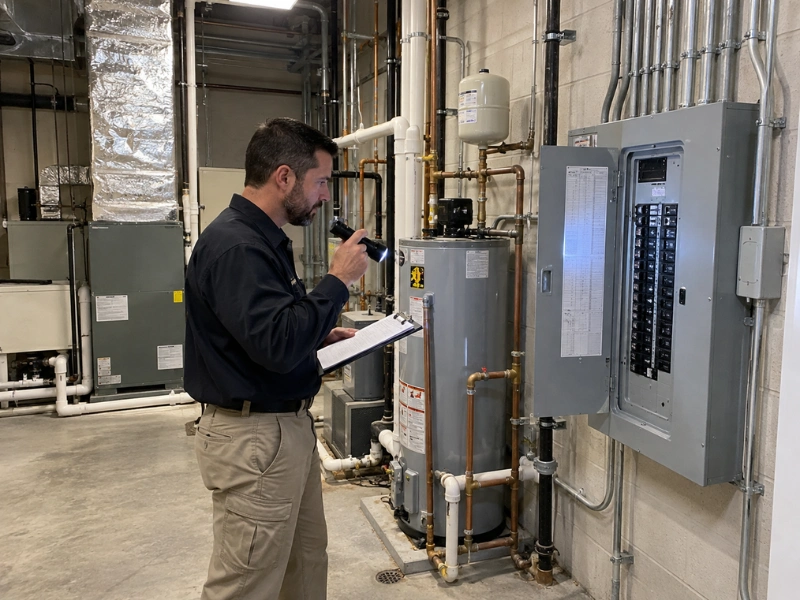
Plumbing | Restroom cores, water heaters, visible leaks and fixtures | Hard water shortens equipment life |
Fire and life safety | Visual review of alarm and sprinkler equipment, exit signs and egress paths | Records and service history matter as much as the hardware |
Accessibility | Parking, entrances, routes and restrooms | Offices open to the public fall under federal ADA rules |
Envelope and site | Stucco cracks, parapets, windows, paving and drainage | Heat cycling and monsoon runoff show up here first |
On fire systems, we visually review alarm and sprinkler equipment and records, but we don't test them. The Chandler Fire Department's fire prevention page says only contractors on the City's approved list may service these systems. So ask the seller for recent test reports from a listed contractor.
Offices open to the public also fall under the federal rules on ADA.gov's Title III page. We flag obvious barriers, but this isn't a compliance audit.
What changes on a multi-tenant property?
Access, ownership and responsibility. A multi-tenant property has more suites to reach, more build-outs to evaluate and more questions about who pays for what.
First, access. Every occupied suite has to be scheduled, and some tenants have security or after-hours limits. As a result, multi-tenant inspections take more coordination than a single-user building.
Second, tenant improvements. Each suite may have its own walls, ceilings, lighting and even rooftop units added over the years. Some of that work may not match the building's original systems.
Third, responsibility. Leases decide whether the landlord or the tenant repairs the roof, the HVAC or the parking lot. So the same finding can be a buyer's cost in one suite and a tenant's cost in another. That's why findings should be marked by location, suite by suite, so your attorney or broker can match them to the leases.
Here's what helps on a multi-tenant inspection:
A suite list and rent roll with tenant contacts
Roof access and any rooftop keys
HVAC service records for each unit
Fire alarm and sprinkler reports from the last few years
Any known leaks, claims or open permits
Our Paradise Valley office inspection guide goes deeper into tenant improvement history and medical suites.
How does a commercial building assessment feed into negotiations?
By separating what needs fixing now from what will need replacing soon. A commercial building assessment is most useful when it shows priority and remaining life, not just a list of defects.
To be clear about scope, our office inspection is a visual inspection report with photos, condition notes and remaining-life observations. It doesn't include repair cost estimates. For dollar figures, buyers usually get bids from roofing, HVAC and other contractors based on the report.
Findings usually fall into three groups. Immediate items, like an active roof leak or a failed rooftop unit, often lead to a repair request or a price reduction. Near-term items, such as a roof with only a few years left, are commonly handled through a credit or an escrow holdback. Long-term items become part of the owner's reserve planning.
In Chandler, roofs and cooling equipment drive the biggest swings. A building with several aging rooftop units and a tired membrane can carry large replacement costs within a few years of closing. Therefore, those two systems are usually where negotiations focus.
Lenders often want a formal property condition assessment instead of a general inspection. That's a separate product, usually prepared to the ASTM E2018 standard by a firm that specializes in lender reports, with cost tables for immediate repairs and future reserves. Ask your lender in writing whether they require one. Our Chandler commercial inspection guide explains when that extra step is worth it.
What drives timing and fees on an office inspection?
Size, floor count, suite count and how much is on the roof. Those four factors shape both the schedule and the fee.
So, how much does an office building inspection cost? It depends mainly on square footage, number of floors, number of suites and number of rooftop units. Add-ons such as thermal imaging or sewer scoping also affect the price. We quote each building after reviewing its size and layout.
People also ask, "How long does a commercial inspection take?" A small single-tenant office may take part of a day on site. Meanwhile, a larger multi-tenant building can take a full day or more, with the report following after. Our guide on how long a commercial property inspection takes breaks down timing by property size.
Where do we inspect office buildings around Chandler and Gilbert?
Across Chandler and the southeast Valley, from the Price Corridor and Chandler Airpark to Downtown Chandler, plus Gilbert, Mesa and Tempe.
If you're looking for office building inspections in Chandler AZ, we're happy to scope the building with you. And if you've asked "who inspects office buildings near Chandler and Gilbert Arizona," we do, along with retail, industrial and multi-unit properties.
If you searched for commercial building inspectors Chandler AZ, see our Chandler commercial inspection page. We also cover Gilbert commercial inspections for properties just east of Chandler.
How do you book an office building inspection?
Call or text us with the address, square footage, number of floors and suites, and your contract dates. Then we'll confirm the scope, quote the inspection and schedule around tenant access.
A good office building inspection gives you clear, prioritized facts, not just a list of problems. To get started, contact Halcomb Property Inspections or call (480) 273-9328. You can also see our full commercial property inspection services.
Frequently asked questions
1. What gets assessed across an office building?
The roof, rooftop HVAC, electrical, plumbing, fire and life safety equipment, accessibility features, the building envelope and the site. Common areas and each accessible suite are included. We don't test fire alarms or sprinklers, and specialty services such as sewer scoping are booked separately.
2. How do size and floor count change cost and timeline?
More square footage, more floors and more suites all add time on site and more to report. Extra rooftop units and multiple electrical services add time too. A small single-story office moves quickly, while a multi-story, multi-tenant building takes longer and costs more.
3. Who usually orders it: buyer, lender or tenant?
Most often the buyer, during the due diligence period. Lenders may require a formal property condition assessment before funding. Tenants sometimes order a limited inspection before signing a long lease, especially if they'll be responsible for repairs.
4. What matters most on a multi-tenant property?
Access to each suite, the condition of shared systems and how tenant improvements were built. Lease terms also matter, since they decide who pays for roof, HVAC and parking repairs. Findings should be organized by suite so they can be matched to each lease.
5. How do roof and cooling findings affect a purchase price?
They're usually the biggest negotiating points. A roof or rooftop units near the end of their life can mean large costs soon after closing. Buyers often get contractor bids based on the inspection report, then ask for a price reduction, a repair credit or an escrow holdback.
6. Does an office inspection check ADA compliance?
It notes visible accessibility issues, such as parking, entrances, ramps and restrooms. However, it isn't a formal ADA compliance audit. For that, you'd need a specialist who reviews the property against the full federal standards.
7. Can you inspect an occupied building without disrupting tenants?
Yes, in most cases. Suite access is scheduled with the property manager, and roof work stays away from busy areas. Early-morning visits can often be arranged for sensitive tenants.
8. What documents should a seller provide?
Roof and HVAC service records, fire alarm and sprinkler inspection reports, recent repair invoices and any open permits are the most useful. A suite list and rent roll also help with planning. Documents fill in what a visual inspection can't see.
Visit or Call Us
Halcomb Property Inspections
Phone: (480) 273-9328 (call or text)
Hours: Mon - Sun 6:00 am - 9:00 pm
InterNACHI-certified inspectors. Arizona state certification applies to residential home inspections; commercial inspections follow InterNACHI standards. Serving Chandler, Sun Lakes, Gilbert, Mesa, Tempe, Queen Creek, San Tan Valley and the Phoenix metro area.
