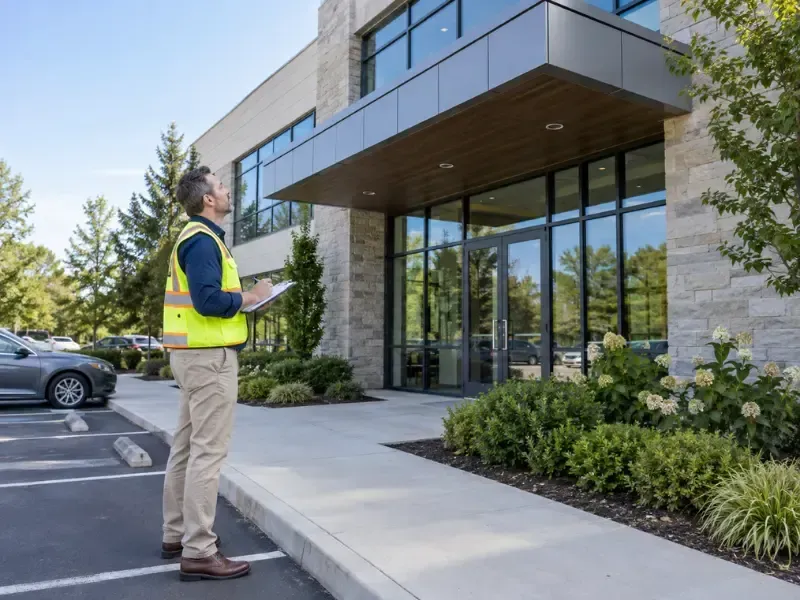
What Does an Office Building Inspection Cover in Paradise Valley?
The building, and then the twenty years of tenant changes layered on top of it. Office property in Paradise Valley is mostly medical and professional suites operating under Special Use Permits, and on those the interesting findings are rarely in the original construction — they're in what successive tenants added to it.
By Alex & Jeff, Certified Home Inspector · Last updated September 9, 2026
Why Does Tenant Improvement History Matter Most?
Because an office building is rarely the building that was designed.
Every tenancy leaves something behind. Partitions moved or added. Circuits pulled for equipment nobody uses now. Data and low-voltage cabling run above ceilings and abandoned in place. HVAC zoning altered so one suite is comfortable and the next isn't. Doors relocated. A break room plumbed into a wall that wasn't planned for it.
Individually, none of that is alarming. Cumulatively it produces four questions an office building assessment should be asking.
Was it permitted? Tenant improvements are permitted work, and unpermitted TI is common. It matters because it transfers with the building, and because an insurer or a future permit application can surface it.
Does the mechanical system still match the floor plan? Zoning designed for an open floor plate performs badly once it's been divided into offices, which shows up as comfort complaints rather than equipment failure — and gets misdiagnosed as an ageing unit.
What's abandoned above the ceiling? Dead cabling, capped circuits, redundant ductwork. Not dangerous, but it's material for a buyer to know about, and abandoned cabling carries its own code considerations.
Where has the roof been penetrated? Every added rooftop unit, exhaust fan, conduit run and satellite dish is a hole through the roof assembly. Which leads to the next section.
What Should You Check on the Roof?
On an office building, more than on a house, because the roof is a working surface.
Most office property here is low-slope with rooftop packaged units sitting on curbs. Those curbs and their flashings are the single most common source of leaks we find on this asset class — not the field of the membrane, but the perimeter of everything sitting on it.
Four things worth specific attention. Curb flashing at each unit, plus any unit that has been replaced with a different footprint on an old curb. Condensate routing, since RTU condensate discharged onto the roof rather than into a drain will destroy a membrane over time. Ponding, because low-slope roofs with drains that have been landscaped over or crushed hold water. And traffic damage, since anyone servicing the units walks the roof and the wear shows.
Our roof inspection guide covers the desert-specific side, including why monsoon dust turns to mud and blocks drains.
What Is Different About a Medical Suite?
This is the Paradise Valley specific, because a large share of the Town's office stock is medical.
A medical office isn't a professional office with different signage. It carries systems a general office doesn't, and a commercial office inspector needs to identify them even where assessing them requires a specialist.
Medical gas piping — where present, installation and certification sit well outside a general inspection scope
Imaging equipment — dedicated circuits, sometimes floor loading considerations, and lead shielding in wall assemblies you can't see
Sterilisation equipment — an autoclave is a plumbing and electrical load, and often a ventilation one
Higher fixture counts and dedicated hand-wash provision, which affects plumbing capacity and drainage
Vacuum and compressed air systems in dental suites
The practical point for a buyer: a medical suite's value depends heavily on whether those systems suit the incoming practice. An inspection tells you condition. Whether the infrastructure fits your intended use is a question for your equipment supplier and your architect.
And the Special Use Permit governs what the property may be used for at all — a point covered in our Paradise Valley commercial guide. Condition and entitlement are separate questions, and a medical use isn't automatically interchangeable with a professional office use.

How Are HVAC, Roofing and Structure Assessed?
What does an office building inspection include on the technical side? Those three are the core of it, alongside the rest.
HVAC on ages, condition and operation, with each unit assessed separately rather than sampled, and with the zoning-versus-floor-plan question above in mind. Refrigerant charge testing sits outside inspection scope, as our HVAC guide explains.
Roofing as described above, with rooftop equipment treated as part of the roof rather than separate from it.
Structure covering foundation, visible framing or structural system, and evidence of movement — plus, on any hillside parcel, the retaining and drainage questions covered in our foundation guide.
Beyond those three: site and paving, electrical service and distribution, plumbing supply and waste, life-safety systems, and ADA-related observations. Worth being precise on that last one — a professional or medical office open to the public is a place of public accommodation, where barrier removal at existing facilities is an ongoing obligation rather than something triggered only by construction. We make observations; certifying compliance is an accessibility specialist's work, and worth commissioning if the property has never been assessed.
What Is a PCA Report, and Do You Need One?
The honest answer, because this is the question that decides whether we're the right firm.
A Property Condition Assessment conducted to ASTM E2018 is a defined product: a Property Condition Report with an immediate-repairs schedule and a replacement-reserves table projecting capital needs across roughly ten to twelve years, expressed as opinions of probable cost rather than contractor bids. Lenders on institutional transactions commonly require it, and a PCA is typically a multi-disciplinary exercise rather than one inspector's work.
A general office property inspection is a different product — a condition assessment for your own information, without the standardised report structure, the reserve modelling, or the lender-facing format.
What you should do regardless: ask your lender, in writing, whether they require E2018 — and if they do, confirm the scope with any firm before engaging them rather than after. Discovering a scope mismatch late costs you the deadline, and no amount of goodwill recovers that.
A Phase I Environmental Site Assessment is separate again, performed by an Environmental Professional, and its protections can't be obtained retroactively.
How Much Does It Cost and How Long Does It Take?
How much does an office building inspection cost turns on floor area, the number of suites and tenancies, building age, how many separate mechanical units serve it, which specialised systems are present, and — dominating everything — which scope you're commissioning.
Why inspect an office building before purchase comes down to the same logic as any income property: you're buying a stream of future expenses as well as a building, and the tenant improvement layers are where the unbudgeted ones hide.
On duration: a small single-tenant suite may be a day. A multi-suite building with several rooftop units, medical infrastructure and twenty years of TI history takes considerably longer, and report turnaround is longer than residential because the capital-planning element has to be assembled properly.
Quotes come from a scoping conversation rather than a rate card, and they're free.
We work across Paradise Valley, Scottsdale and Phoenix — see our commercial inspections page, the assets we cover on property types, and the area list on our locations page.
If you're searching for an office building inspection near me Paradise Valley AZ, or comparing an office building inspector Paradise Valley Arizona buyers use, settle two things first: what scope your lender requires, and what the Special Use Permit permits. An office property inspection near Paradise Valley is straightforward once those are known and guesswork until they are.

Frequently Asked Questions
1. What does an office building inspection cover?
Building envelope and roof including rooftop equipment and curb flashings, structure and foundation, site and paving, electrical service and distribution, plumbing supply and waste, HVAC with ages and estimated remaining life assessed unit by unit, life-safety systems, and ADA-related observations. On office property specifically it also means examining tenant improvement history — partitions, added circuits, altered HVAC zoning, abandoned cabling above ceilings — since that layering is where most unbudgeted expense on this asset class is found.
2. How much does an office building inspection cost in Paradise Valley?
Floor area, number of suites and tenancies, building age, how many separate mechanical units serve the property, which specialised systems are present, and above all which scope you are commissioning. A general condition inspection of a single-tenant suite and a full Property Condition Assessment on a multi-suite medical building are not comparable engagements and shouldn't be compared on price. Quotes come from a scoping conversation rather than a rate card, and they are free.
3. How long does the inspection take?
A small single-tenant office suite may be a day. A multi-suite building with several rooftop packaged units, medical infrastructure and two decades of tenant improvement history takes considerably longer, since each mechanical unit is assessed separately rather than sampled and the TI layers need tracing. Report turnaround is longer than on residential work because the capital-planning element — equipment ages, remaining life, likely expenditure — has to be assembled properly rather than delivered same-week.
4. Do you assess HVAC, roofing, and structure?
Yes, those three are the core. HVAC on age, condition and operation, with each unit assessed individually and with attention to whether zoning still matches a floor plan that tenant improvements have changed — refrigerant charge testing sits outside inspection scope. Roofing with rooftop equipment treated as part of the roof, since curbs and their flashings are the commonest leak source on this asset class. Structure covering foundation, visible structural system and evidence of movement, plus retaining and drainage on hillside parcels.
5. Do you provide a PCA report?
A Property Condition Assessment to ASTM E2018 is a specific product: a Property Condition Report with an immediate-repairs schedule and a replacement-reserves table projecting capital needs over roughly ten to twelve years, as opinions of probable cost rather than bids. Lenders often require it and it is usually a multi-disciplinary exercise. A general office condition inspection is a different product without that report structure or reserve modelling. Ask your lender in writing whether E2018 is required, then confirm scope with any firm before engaging rather than after.
Contact Halcomb Property Inspections
Halcomb Property Inspections Serving Paradise Valley, AZ and the Phoenix metropolitan area Phone: (480) 273-9328 Hours: Monday–Sunday, 6:00 AM – 9:00 PM Serving Paradise Valley, Scottsdale, Phoenix, and the wider Valley.
Buying an office suite? Request a free quote or call (480) 273-9328 — tell us the scope your lender specified and we'll say straight away whether it's work we do.
