Which Pool Inspection in Phoenix Should Buyers Order?
Phoenix buyers should order a pool inspection that looks at the equipment, the shell, the electrical work and the safety barrier, and they should book it in the first days of the inspection period. Halcomb Property Inspections can add one to your property inspection anywhere in Phoenix, so a single visit covers the house and the pool.
By Alex & Jeff, Certified Home Inspector · Last updated October 12, 2026
Pool Inspection Phoenix: What Arizona's Standard Covers and Skips?
In Arizona, a certified home inspector doesn't have to look at the pool at all. The Board of Technical Registration says so in its rules. If the inspector does take it on, the work has to follow the Board's Pools and Spas Standards of Professional Practice. So when two reports both say "pool checked," they may not mean the same thing.
The standard is visual, and it isn't technically exhaustive. The inspector looks at what's easy to reach, runs whatever responds to the normal controls, and writes down what was and wasn't inspected. Here's roughly where the line falls.
Area | What the state standard has the inspector observe | What it doesn't require, so ask |
Pad equipment | Pumps, motors, filter, heater, gauges, visible piping and valves | How long each unit has left, or whether the filter and heater are sized right |
Electrical | Bonding on pump motors, blowers and heaters, visible wiring, underwater lights, GFCIs and timers | Bonding on other equipment, or stray voltage |
Shell and finish | Interior finish, decking, steps and coping | Leaks in the shell or underground plumbing, or structural integrity |
Safety | Whether a child-safe barrier and entrapment-prevention parts are present | Whether they meet local code |
Water | Cross connections in the supply | Water chemistry and clarity |
That's not a knock on inspectors. It's just how the standard is written. Think of the report as a snapshot of what's visible and working that day, and decide for yourself which items need a specialist before the inspection period runs out.
Pool Equipment and Pump Inspection Phoenix: What Summer Heat Does to the Pad?
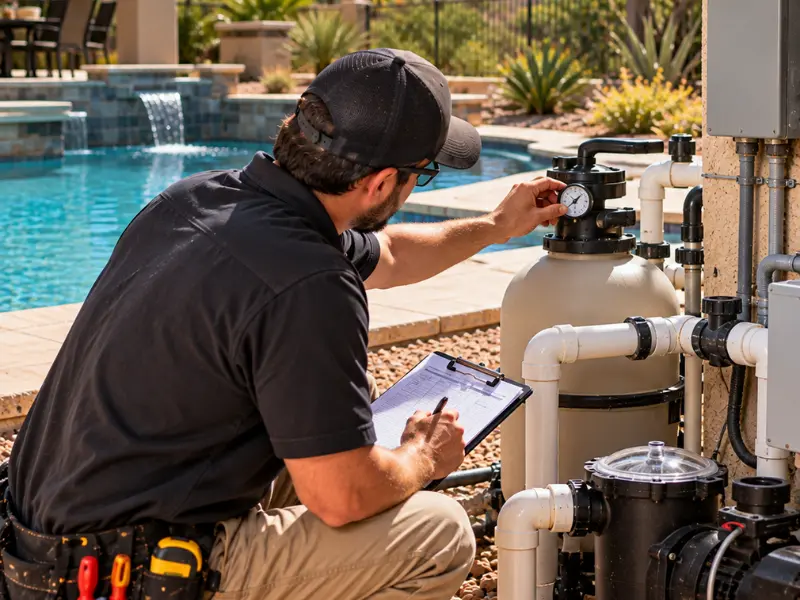
Pool service companies, leak specialists, home inspectors. What matters more is whether the person actually turns the equipment on and watches it run. Anybody can confirm a pump exists.
Heat is the thing to keep in mind. The pad sits in full sun, pumps run for hours on summer days, and hard water leaves scale on heaters and salt cells. A pool can look great and still have a motor on its last legs, or a heater nobody has fired since spring. So we start the pump, filter and controls, read the gauges, look over the connections, and note how old each piece appears.
You can spot some warning signs yourself at a showing:
White crust or rust around the pump base, fittings and filter clamps
A pump that sounds rough, hums, or struggles to prime
A filter gauge that sits at zero or never moves
Wiring or conduit near the pad that looks patched or exposed
Any one of those is only a hint. But it tells the inspector where to start.
Pre Purchase Pool Inspection Phoenix: Getting the Timing Right
Timing matters more. Arizona REALTORS' standard resale contract gives you 10 days after acceptance unless you agree to something else, and every inspection has to be finished before you send the seller your inspection notice. A leak specialist might not have an opening for a week. So book the pool inspection on day one, right alongside the house. If it finds something, you've still got room to bring someone else in. Our guide to the 10-day inspection period walks through how those days add up.
Two more things. First, A.R.S. § 36-1681 says anyone selling a home with a pool has to hand the buyer a pool safety notice, and the same law sets the barrier rules. Ask your agent whether you got yours. Second, ask the seller for pool service records. A folder of old invoices tells you what's been swapped out and what's original. If you'd like the house inspected on the same trip, our home buyer inspection page for Phoenix shows how that works.
Pool Companies, Leak Specialists and Home Inspectors
Pool service companies maintain and repair pools, and some will inspect one too. Leak specialists find water loss with pressure tests, dye and listening gear. Certified home inspectors can add a pool inspection to the house and follow the state standard we just went through.
Buyers also ask which inspector adds a pool inspection to a home inspection. The easy answer is the one who'll do both in a single visit. We do. Just tell us about the pool when you book so we can leave enough time. Our guide to a property inspection in Phoenix shows how the house and the add-ons fit together.
One more thing worth knowing. Arizona's rules keep a certified home inspector from doing repairs on a house they inspected, or profiting from them, for 24 months. A company that sells the fix has a different incentive than one that can't. That rule covers us, and we don't work for realtors or sellers.
Where We Inspect Pools Across Phoenix?
We cover all of Phoenix. That means older central neighborhoods like Arcadia and the Biltmore area, Ahwatukee, and the newer north Phoenix communities around Desert Ridge. Age changes what we expect to see. In the older central areas, pools are often decades old, with equipment swapped out piece by piece and a barrier added later. Up north, builder-installed equipment tends to be coming up on its first replacement.
We also work in Scottsdale, Tempe and Glendale. Our swimming pool inspection guide for Peoria covers the west side of the Valley, and our pool inspections page lists everything the service includes. Ready to book? Request a free quote or call (480) 273-9328.
Frequently Asked Questions
1. What does a pool inspection include?
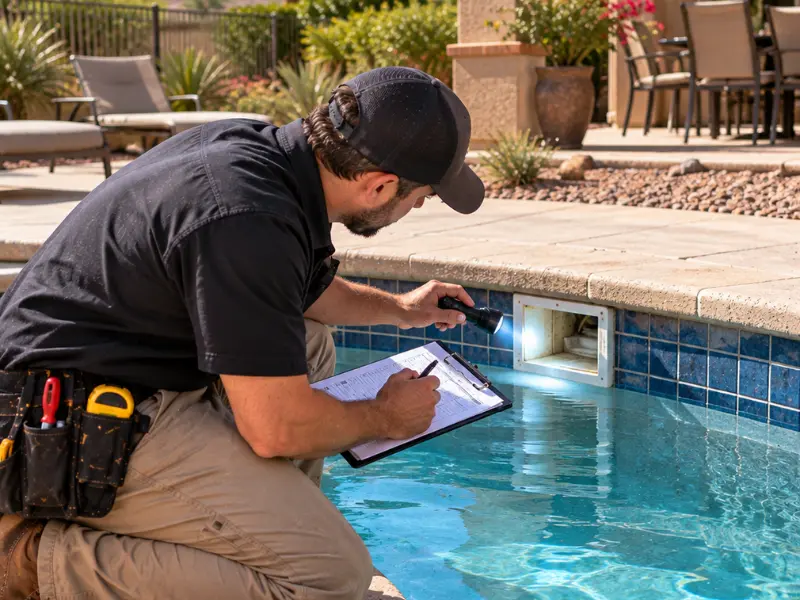
Everything we can see and run. That starts with the equipment: pumps, filters, heaters, timers and automation, chlorinators, blowers, lights and valves. Then the shell, decking and coping, and any cracks, stains or signs of leaks. For safety we check fencing, self-latching gates, alarms, safety covers and anti-entrapment drain covers. We also look at grounding, GFCI protection, slip-resistant surfaces, water level and clarity, and how the area around the pool drains.
2. Can you add a pool inspection to my property inspection?
Yes, we can. Mention the pool when you book and we'll cover the house and the pool on the same trip. You schedule once, with one company, instead of chasing a second appointment while your inspection period keeps ticking.
3. Can you tell whether a pool is leaking before I buy?
Not for certain. We can tell you what's visible, but we can't confirm a leak. Arizona's pool inspection standard doesn't require reporting on leaks in the shell or underground plumbing, so we look for clues: wet ground near the pad or shell, cracks along the tile line, equipment that struggles to hold prime. Phoenix heat makes it harder, because evaporation can hide a slow leak. If something looks off, a leak specialist can pressure-test the lines, usually for a few hundred dollars, and we'll point you to one.
4. Do you check pool barrier and safety gate requirements?
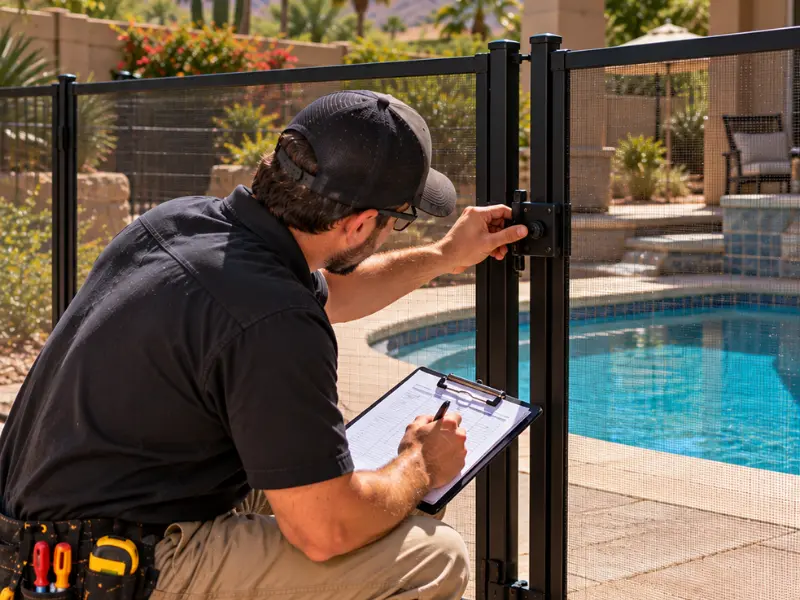
Yes. We look at the fence, gates, alarms and covers and compare them with Arizona's barrier statute. If something looks short, we flag it, though only the city can sign off on code compliance. The statute wants a barrier at least five feet high, with no opening a four-inch sphere can pass through and nothing climbable on the outside. It also has to sit at least 20 inches from the water. Gates must open outward and be self-closing and self-latching, with the latch at least 54 inches off the ground or on the pool side of the gate. There's a catch, though. The law doesn't apply where everyone living in the home is six or older, and cities can set stricter rules, so check with the City of Phoenix.
5. How much does a pool inspection cost in Phoenix?
Plan on roughly $150 to $350 for a pre-purchase pool inspection in the Phoenix area, going by published 2026 price guides. Angi puts a professional pool inspection at $125 to $250 nationally. The number moves with pool size, how much equipment there is, whether there's a spa, and whether you're adding it to a property inspection. Our quote is free. Tell us about the pool and we'll give you a number.
6. How long does a pool inspection take?
Most take one to two hours. A bigger pool with a spa, a heater and automation runs longer. If you're pairing it with a home inspection, which usually takes two to three hours, plan on a big chunk of your day. The written report arrives within 24 hours, often the same day.
7. Do you inspect spas and hot tubs too?
Yes. We check spa jets and how they work as part of the pool inspection. Arizona's standard covers any contained body of water at least 18 inches deep that's meant for swimming or immersion, so a built-in spa attached to the pool counts. A freestanding hot tub is a different case. Mention it when you book and we'll confirm what we can look at.
8. Do I need to be there during the pool inspection?
You don't have to, but it helps. Walking the pad with us lets you hear what's normal for that equipment and what isn't, and you can ask questions on the spot. Bring the seller's disclosure and any pool service records you have, since they show how long things have been in place. Can't stay the whole time? Join the final walkthrough.
Visit or Call Us
Halcomb Property Inspections Phone: (480) 273-9328 Hours: Monday to Sunday, 6:00 AM to 9:00 PM Serving Phoenix, including Arcadia, the Biltmore area, Ahwatukee and Desert Ridge, plus Scottsdale, Tempe, Glendale, Peoria and the wider Valley.
