What Do Pool Inspections Reveal In Older Phoenix Homes?
Pool inspections on an older Phoenix home reveal the pool's real history: how many summers of heat and hard water it's been through, what's been patched or upgraded along the way, and whether that work was done properly. A 40-year-old pool can be in great shape or quietly costing its owner a fortune. At Halcomb Property Inspections, we help buyers tell the difference before the inspection window closes.
By Alex & Jeff, Certified Home Inspector · Last updated November 13, 2026
Why do pool inspections matter more on an older Phoenix pool?
Because an old pool has had decades to collect repairs, upgrades and shortcuts, and most of them aren't written down anywhere. A pool built five years ago is mostly the original design. One built in 1975 has probably had new equipment several times, a new surface or two, maybe a spa added, maybe a waterfall that was later shut off.
In practice, age tends to follow the neighborhood. In central Phoenix, around Arcadia and the older streets near Camelback, plenty of backyard pools date from the '50s and '60s. Maryvale and much of west Phoenix filled in through the '60s and '70s. Ahwatukee and Dobson Ranch in Mesa are mostly '70s and '80s builds, while Desert Ridge and the newer parts of Mesa are much younger. So if you're buying a Phoenix house with an older pool, the zip code alone gives you a rough idea of what to expect.
Still, that doesn't mean old is bad. Some of the best-built pools we see are in the oldest neighborhoods. It just means there's more history to read, and the report has more to tell you.
How do Phoenix water and heat age a pool over the years?
Slowly, and mostly through minerals. Phoenix water is hard, and our heat evaporates a lot of it every summer. Each time you top the pool back up, you add more calcium and dissolved solids, and the water you lost to the air doesn't take any of it with it.
The EPA's WaterSense pool water efficiency guide explains why that matters. Total dissolved solids build up over time, a well-kept pool typically needs draining every 3 to 7 years to bring them back down, and mobile reverse osmosis is an alternative to dumping all that water. The same guide warns that a chemical imbalance can corrode a pool and lead to structural damage.
On an older pool, that buildup shows up in a few places:
A white crust along the tile line, where scale has built up at the waterline for years
Rough patches on steps and benches where minerals have etched in
Scaled-up return fittings and skimmer throats
Staining around metal fittings and lights
The EPA guide also gives a useful rule of thumb for leaks. In hot, dry places, losing more than 3 inches a week suggests something more than evaporation. A simple bucket test, comparing the pool's water loss with a bucket set on the step, helps sort out which it is.
Which records should you ask the seller for?
Anything that shows what's been done to the pool and when. Sellers with older pools often have a folder of paperwork they've never been asked for, and it can save you a lot of guessing.
Record | What it tells you | What to watch for |
Original pool permit or plans | Size, depth and when it was built | Pool shape no longer matches the plans |
Remodel and resurfacing invoices | What work was done, and when | Big gaps with no work at all |
Repair receipts | Which parts were replaced, and how often | The same repair, over and over |
Pool service logs | How consistently it's been maintained | Long stretches with no service |
Leak detection reports | Whether a leak was found and fixed | A leak found but never repaired |
HOA pool or fence rules | What you're required to keep up | Open violations tied to the pool |
That said, don't worry if the seller can't produce all of it. Even a couple of receipts help us line up what we see on site with what actually happened. And if the seller says "no work has ever been done" on a 50-year-old pool, that's worth noting too.
Want an older pool checked before your window closes?
Call: (480) 273-9328
Hours: Mon - Sun, 6:00 AM to 9:00 PM
Free quote, with a digital report within 24 hours.
How can you check for unpermitted pool work?
Compare what's in the backyard with what's on file. Older pools often pick up extras over the years, like an attached spa, a rock waterfall, a gas heater or a slide, and not every one of them went through a permit.
The City of Phoenix's My Community Map lets you search an address and see permit and plan review activity on the map. It isn't a full history of every permit ever pulled, but it's a good first look. For a fuller record, the Planning and Development Department can help, and Mesa and the other Valley cities have their own records offices.
Once we're on site, a few things hint that work skipped the permit:
A spa or water feature that clearly doesn't match the original pool's style or materials
A gas line running along the ground to the heater instead of buried
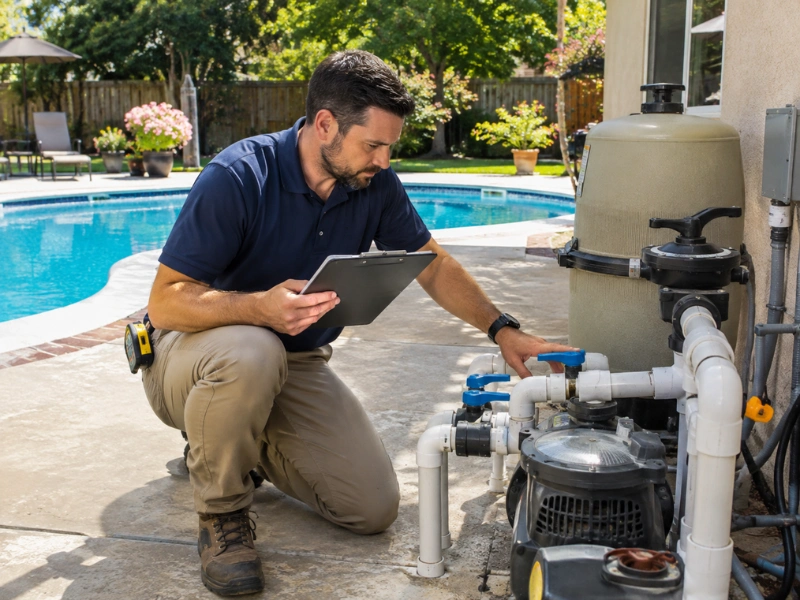
Extra breakers or wiring at the equipment that look homemade
A pool that's been reshaped or extended at one end
None of that automatically means a problem. But unpermitted work can be harder to insure, and fixing it later usually falls to whoever owns the house at the time, which is why we'd rather you find out now.
When does filling in a pool make more sense than fixing it?
When you never wanted a pool in the first place, and the one you're buying needs serious work. Some buyers would rather have the yard back, and an inspection that shows heavy repairs ahead makes that conversation easier.
If you go that route, there are generally two ways to do it. A partial fill breaks up the bottom for drainage and backfills the shell where it sits, which costs less but leaves the old pool underground. A full removal takes the shell out completely and compacts the soil, which costs more but leaves a yard you can build on later without surprises.
Either way, check with the city before anyone starts digging, since removal usually needs a permit and inspections. Also, keep the paperwork. Future buyers and their inspectors will want to know what's under the lawn, and a filled-in pool with no records can raise more questions than the pool itself ever did.
We don't remove pools ourselves, so we have no stake in which way you go. We just give you the condition report you need to weigh the options.
Where do we offer pool inspections around Phoenix and Mesa?
Across the Valley. If you're searching for pool inspections in Phoenix AZ, our Phoenix page covers the neighborhoods we work in most, from central Phoenix out to Ahwatukee and Desert Ridge. And if you need pool assessments near Phoenix and Mesa AZ, we're out in Mesa regularly too, along with Scottsdale, Tempe, Chandler, Gilbert, Glendale and Peoria.
For the full checklist of what we look at, see our pool inspections page. Our earlier guide to which pool inspection Phoenix buyers should order covers scope and timing. And since everything has to fit inside your contract, our 10-day inspection period guide explains how to plan the days.
Frequently asked questions
1. How much life is left in the pool surface?
Standard white plaster usually lasts around 7 to 12 years, while quartz and pebble finishes often run 12 to 20 years or more, which is the honest answer to how long does pool plaster last here. Pool surface and resurfacing life also depends on water chemistry, so we look for etching, roughness, staining and bare spots to judge how much is left.
2. How old is the pump and filter, and what does replacing them cost?
Most pumps last about 8 to 12 years and filters a little longer, and the date code on the equipment label usually tells us their age. The usual answer to how do you tell if pool equipment is near the end is loud running, leaking seals or tripped breakers, and replacing older pool equipment with a variable-speed pump often runs about $1,200 to $2,500 installed.
3. What does a pool actually cost to run through a Phoenix summer?
Many Phoenix owners spend roughly $100 to $250 a month in summer between electricity, chemicals, water top-ups and service, which is the short answer to what does it cost to run a pool in Phoenix. What a pool costs to run drops a lot with a variable-speed pump and a cover, and rises with an old single-speed pump running long hours.
4. Is a neglected pool a negotiating point or a reason to walk?
Usually a negotiating point, since a green pool with sound equipment and a solid shell often needs cleaning and chemistry rather than major repair. It becomes a reason to walk when the inspection finds structural cracks, an active leak or failed equipment that together cost more than the seller will credit.
5. What is checked around the pool as well as in it?
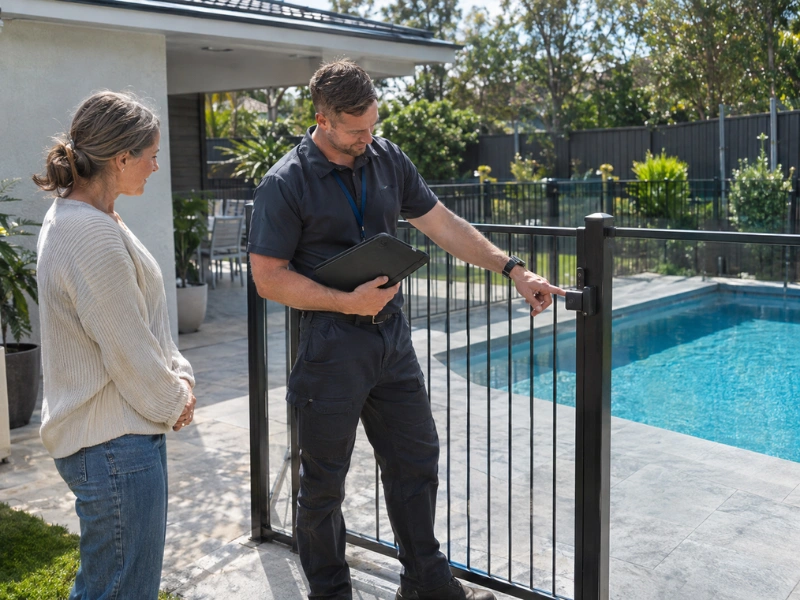
Around the pool, we check the barrier fence, self-closing and self-latching gates, door alarms, the deck and coping, and the electrical bonding and GFCI protection. In the water, we look at drain covers, lights, skimmers, returns and the visible shell for cracks or leaks.
Visit or Call Us
Halcomb Property Inspections
Address: Serving the Phoenix metropolitan area (no storefront)
Phone: (480) 273-9328
Hours: Mon - Sun, 6:00 AM to 9:00 PM
InterNACHI-certified inspectors, licensed and insured in Arizona.
Serving Phoenix, Mesa, Scottsdale, Tempe, Chandler, Gilbert, Glendale and Peoria. Call for a free estimate, or use our contact page to book a visit.
