What Does A Swimming Pool Inspection Catch In Chandler?
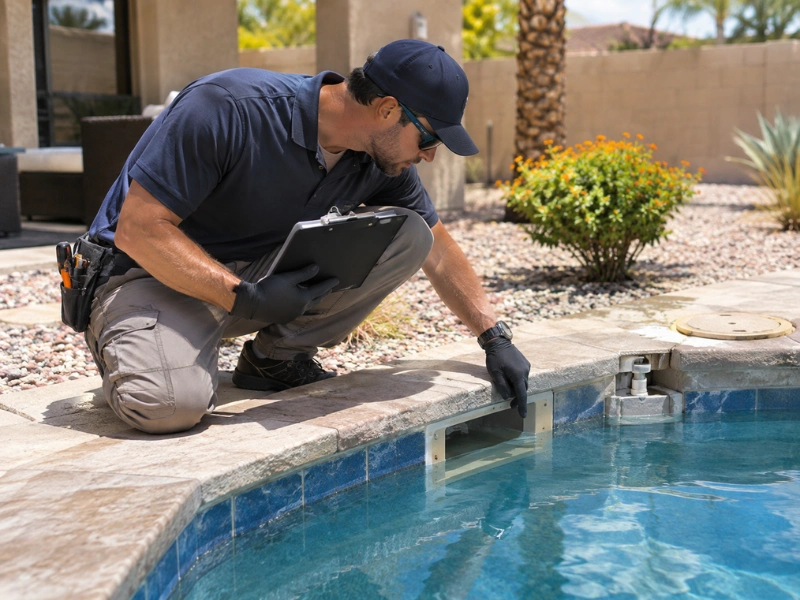
A swimming pool inspection in Chandler catches the visible signs of a pool losing water. Think damp soil along plumbing runs, crusty drips at the equipment pad, tile line cracks and a deck pulling away from the coping. At Halcomb Property Inspections, we photograph every clue. We also tell you plainly when a leak specialist is the next call.
By Alex & Jeff, Certified Home Inspectors · Last updated November 26, 2026
Why does Chandler's climate make water loss so hard to read?
Water loss is hard to read here because the desert pulls water out of a pool fast. A real leak can hide inside normal evaporation for months. Low humidity, strong sun and afternoon wind all speed it up.
The swing across the year is huge. The City of Scottsdale's evaporation estimate puts a 400-square-foot pool at about 19,665 gallons a year. June alone loses roughly four times as much as January. In other words, the same pool can look healthy in winter and alarming in early summer without anything being wrong.
Monsoon season adds its own twist. Humidity climbs from July into September, so evaporation actually eases a little. However, dust storms bring more backwashing and splash-out. Both drop the level in ways that look like a leak.
A few things push loss even higher:
Waterfalls, sheer descents and spillways that spread water into the air
Heated pools and spas, since warm water evaporates faster
Pebble finishes in dark colors that soak up more sun
No shade on the west side during long afternoons
What does a swimming pool inspection check when a pool is losing water?
A swimming pool inspection checks every visible place water can escape and photographs what it finds. It doesn't drain the pool, dive the shell or pressurize buried lines. Think of it as a careful visual and moisture check, not leak detection.
Where we look | What we're looking for | Why it matters |
|---|---|---|
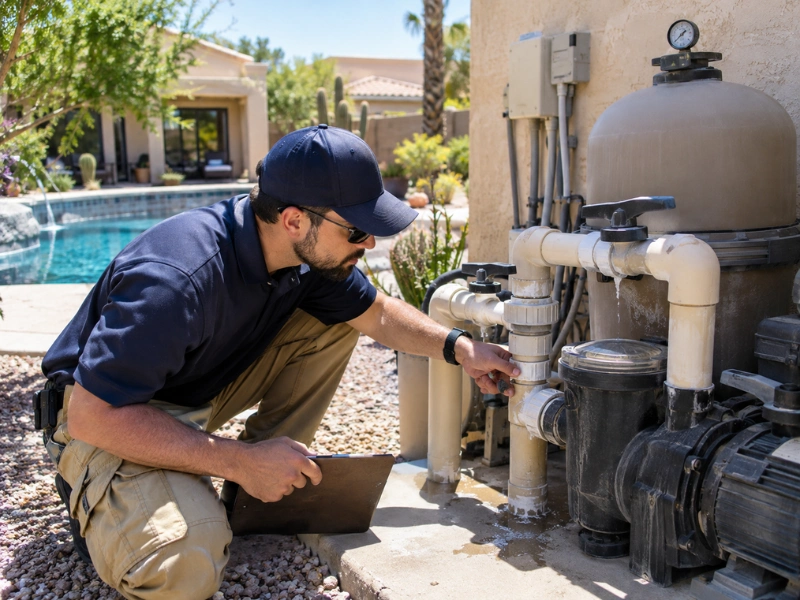
Equipment pad | Drips at unions, pump lid seals, filter clamps and valves; white crust on pipes | Mineral crust often marks a slow leak that dries before anyone sees it wet |
Ground along plumbing runs | Soft or damp soil, sunken pavers, weeds greener than the rest of the yard | Buried lines leak into the soil long before the pool level gives it away |
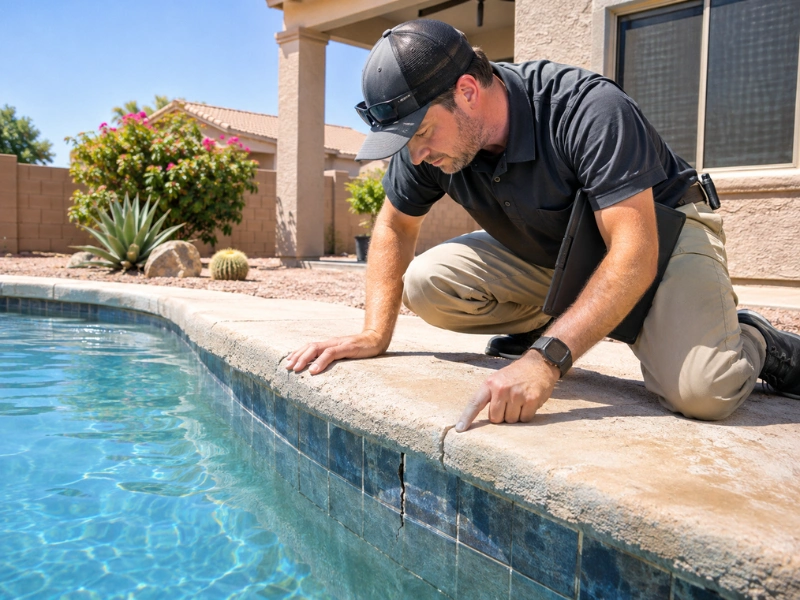
Tile line and coping | Cracks, missing grout, gaps at the expansion joint | Water slips behind the tile and works into the bond beam |
Deck | Settling, lifting or separation at the pool edge | Moving soil under the deck can point to water washing it out |
Skimmer and returns | Cracks or separation where fittings meet the plaster | These joints flex every summer and winter |
Autofill | Running when it shouldn't, overflow, damp ground at the valve | A busy autofill quietly replaces lost water and masks the drop |
There's also a limit worth knowing. Arizona's pool and spa standards of practice don't require inspectors to report leaks in the shell or underground parts. So when the signs point to a hidden leak, we say so clearly and recommend a specialist rather than guessing.
Is your autofill running more than it should?
Call or text: (480) 273-9328
Offer: Free quote on a pool inspection
How does pool water chemistry give a leak away?
Chemistry gives a leak away because evaporation and leaks affect dissolved minerals in opposite directions. Evaporation removes only pure water, so salt, calcium and stabilizer get more concentrated over time.
A leak works the other way. It takes out whole pool water, minerals and all, and then the autofill tops it up with fresh tap water. As a result, the readings keep sliding down even though you're adding chemicals.
That's why a pool service log is worth asking for. Does the salt reading keep dropping on a saltwater pool? Does stabilizer need topping up every few weeks? Then the water is probably leaving through the pool, not into the air.
Which tests pinpoint a pool leak once it's confirmed?
Dye, pressure and listening tests pinpoint a leak, usually in that order. If you've searched "how do you find a pool leak," know that this step normally needs a leak detection company. A home inspector's job ends at spotting the signs.
Here's how that work usually goes:
Dye testing comes first. The pump goes off so the water sits still. Then a few drops of dye near a crack, return or light niche will drift straight in if water is escaping.
Pressure testing comes next for buried lines. A specialist plugs each line and pressurizes it, and a line that won't hold pressure is the one leaking.
Listening gear then finds the exact spot. It picks up the sound of water escaping underground. That way, only a small section of deck needs to come up.
One tip before anyone arrives: don't backwash, drain or refill more than you have to. A stable level gives the specialist a cleaner reading.
Why can the autofill hide a leak for months?
An autofill hides a leak because it quietly replaces the lost water. The level never drops enough to notice. Often the only clue is the water bill, and in summer most people blame evaporation for that too.
That's why we always note whether the autofill is running during the inspection. If you're the owner, shut the autofill off at its supply valve for a few days and watch the level. Then compare a summer water bill with a winter one. If the gap looks bigger than evaporation explains, it's worth a closer look.
When should Chandler buyers raise water loss during escrow?
Buyers should raise water loss inside the inspection period, because that's the window to ask questions and negotiate. It's short in Arizona's standard resale contract. Our guide to the 10-day inspection period explains how to use it.
So book the pool early in that window. If our report flags leak signs, there's still time for a leak specialist to test the lines before your deadline. It's also fair to ask the seller for a year of water bills and pool service records. Both show patterns a single visit can't.
For everything else a full pool inspection covers, read what pool inspections find in Arizona heat.
Where do we run pool leak checks around Chandler and Ahwatukee?
We run pool leak checks in Chandler AZ and across the southeast Valley through our Chandler pool inspection services. Calls often come from Ocotillo, Fulton Ranch and Andersen Springs. In Ahwatukee, we're often in Mountain Park Ranch and the Foothills.
We also cover nearby cities, including Gilbert, Tempe and Mesa. Searching for pool assessments near Chandler and Ahwatukee AZ? A swimming pool inspection can stand alone or join a full home inspection. Either way, you'll get a photo report that separates normal desert wear from real warning signs. You can also see everything we check on our main pool inspections page.
Frequently asked questions
1. The level keeps dropping - is that a leak or just the heat?
It's probably a leak if the level drops as fast in November as it did in July, since heat-driven loss shrinks as the weather cools. That pattern is the simplest answer to how do you tell if a pool is leaking or evaporating, though telling evaporation from a leak on a Chandler pool in midsummer needs a side-by-side test.
2. How much is normal to lose in an Arizona summer week?
Two to two and a half inches a week is normal for an uncovered pool in June and July, based on Valley city estimates. That's the practical answer to how much water does a pool lose to evaporation in summer, and water features can push it higher.
3. Is it the shell, the fittings, or the pipework underground?
Comparing a day of loss with the pump running against a day with it off answers "is it the shell or the plumbing" for most pools, since extra loss with the pump on points to the pipework. If the loss is the same either way, the shell or a fitting like the skimmer, a return or the light niche is likelier.
4. What is the bucket test and does it actually tell you anything?
The bucket test sets a bucket of pool water on the top step and compares both drops after two or three days, measuring evaporation against a leak under the same sun. It tells you whether a leak exists but not where, and rain, wind or splashing can skew it.
5. What does chasing a leak cost against living with it?
Chasing a leak costs a specialist's detection visit plus a repair that ranges from resealing a fitting to opening the deck. Living with it costs extra water and chemicals every month, and it can wash out soil under the deck until a small leak becomes a structural repair.
Visit or Call Us
Halcomb Property Inspections
Phone: (480) 273-9328 (call or text)
Hours: Monday to Sunday, 6:00 AM to 9:00 PM
InterNACHI-certified home and pool inspectors serving the Phoenix metro
Serving Chandler, Ahwatukee, Gilbert, Tempe and Mesa. Call for a free quote, or use our contact page to book an inspection.
