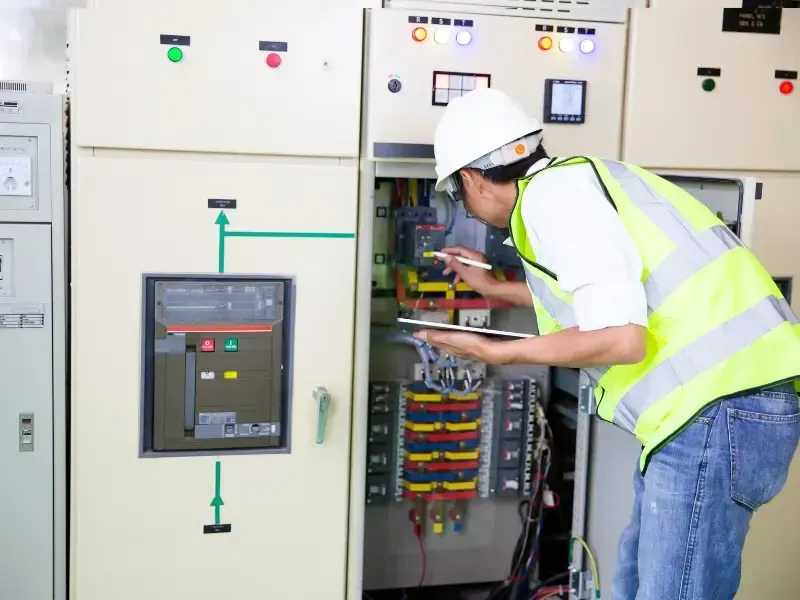
What Does an Electrical Inspection Check in Mesa, AZ?
The panel, the wiring you can see, the protection devices, and whether any of it can carry what you plan to add. That last part is where most Mesa inspections get interesting, because a lot of homes here are being asked to run a second air conditioner, an EV charger, and a rooftop solar array on a service sized in 1978.
By Alex & Jeff, Certified Home Inspector · Last updated August 13, 2026
What Does an Electrical Inspection Check?
Ask what does an electrical inspection check and the list divides into four parts.
The service. Size in amps, the meter and main disconnect, entrance conductor condition, and grounding and bonding. Grounding is the item most often found wrong in older homes, and the one with the least visible symptom.
The panel. Manufacturer and whether breakers are the right type for the bus, double-tapped breakers, evidence of overheating at terminations, missing filler plates, and whether there's any spare capacity left.
Branch circuits. Conductor material, splices outside boxes, junction boxes without covers, and abandoned circuits still energized.
Protection devices. GFCI at wet locations and AFCI coverage, tested at the device rather than assumed from the breaker label.
A home electrical safety inspection Arizona buyers commission during escrow covers all four visually and by operation. What it doesn't include is a load calculation or anything requiring the power off. For deeper capacity analysis across mechanical, electrical, and plumbing together, our MEP inspection guide covers that scope, and the broader house is in our buyer checklist.
Inspector or Electrician?
Both, and the order saves money.
An inspector removes the dead front where it's safely accessible, documents what's there, tests protection devices, and reports what needs an electrician. Arizona home inspectors are certified through the State Board of Technical Registration and work to a defined scope — the Board's home inspection information sets out what that involves. It's a visual and operational scope.
A licensed electrical contractor, licensed in Arizona through the Registrar of Contractors, does the rest: load calculations, circuit tracing with the power off, thermal testing under load, and any repair or replacement.
So a residential electrical inspector Maricopa County buyers hire will tell you the panel is 100 amps, full, with heat damage at two terminations. What that costs to fix is an electrician's answer. Reverse the order and you pay a service call to learn what an inspection would have told you. Go straight to an electrician if something isn't working, if you smell burning, or if an inspection has flagged the panel.
Does Your Panel Need Replacing?
Four things push a panel toward replacement, and only one of them is age.
Capacity. A 100-amp service was adequate for a 1970s Mesa house. It isn't adequate for two air conditioning systems plus an EV charger, and it may not be adequate for solar. This is the most common finding.
Obsolete equipment. Certain older panel brands have documented breaker-failure histories and are widely treated as replace-on-sight rather than repair. Our guide to things that fail a home inspection covers which ones and why.
No spare slots. A full panel means every future addition needs a subpanel or a replacement anyway, so the economics often favor doing it once.
Evidence of heat. Discolored terminations, a burnt smell, or a breaker that trips warm are all findings that go to an electrician promptly.
Anyone asking which inspector handles older panel inspections in Mesa AZ should expect the inspector to open the panel, photograph what's inside, and name the manufacturer — not offer an opinion on what the repair costs.

Solar Changes the Panel Question
Here's the part specific to Arizona, and it catches homeowners who think adding solar is a roof decision.
Solar feeds power into your panel, and the code limits how much. Under NEC Article 705, the most common residential method places the solar breaker at the opposite end of the busbar from the main, and the sum of the main breaker rating plus the solar breaker cannot exceed 120% of the busbar's rating. Penn State's interconnection methods coursework works through the arithmetic, and it's simple enough to run yourself.

Look at the last row. Downsizing the main breaker on a 200-amp bus frees up a lot of headroom for solar. That's a legitimate code path, and it's often cheaper than upgrading the panel — which is exactly the kind of thing worth knowing before a solar company tells you a service upgrade is unavoidable.
Look at the first row too. On a 100-amp service, the load-side method caps you around 3.8 kW, which is a small array by Arizona standards. If you want more, the options are downsizing the main, upgrading the bus, or a supply-side tap.
Which edition of the code Mesa currently enforces is worth confirming with the City, since the section numbering has moved between cycles and the details vary. But the arithmetic is stable, and it means an electrical panel inspection Phoenix metro homeowners get before going solar can save a redesign. We note bus rating and main breaker rating separately in the report, because they aren't always the same number and the calculation needs both.
Why Mesa Attics Are Hard on Wiring
A detail that gets overlooked, and it's genuinely local.
Conductor ampacity is rated at an assumed ambient temperature. Run the same wire somewhere much hotter and it carries less current safely, so the code applies a correction factor. A Phoenix-area attic in July runs far above the temperature those base ratings assume — which means wiring installed in an attic here is derated compared with identical wiring in a basement in Ohio.
Three things follow. Attic junction boxes and splices deserve a closer look than they'd get in a mild climate. Circuits marginal on paper can be genuinely marginal in August. And attic-mounted air handler circuits, common here, sit in the worst place for it.
The finding we write up most: abandoned wiring from a removed evaporative cooler, still energized, unlabeled, often spliced outside a box. If your house switched from evap to refrigerated air, that circuit is probably still up there. Our HVAC guide covers the equipment side.
Danger Signs, Cost, and Where We Work
Signs worth acting on: breakers tripping repeatedly on one circuit, warm or discolored outlets and switch plates, a burning smell with no source, lights dimming when the AC starts, two-prong outlets with no ground, and any scorch mark. Also extension cords doing permanent duty, which is a symptom rather than a habit.
On aluminum: yes, aluminum branch-circuit wiring is a real concern in Mesa homes wired roughly between the mid-1960s and early 1970s. Aluminum isn't unsafe in itself, but its terminations are the weak point, since it expands and contracts more than copper and loose connections heat. The question isn't whether to rewire the house — it's whether the devices are rated for aluminum and whether terminations have been properly pigtailed. Our MEP guide goes into it further, and insurers do ask.
On budget, how much does an electrical inspection cost depends on bundling. Within a full residential inspection the electrical scope is standard rather than extra. As a standalone visit it's shorter and priced accordingly. Multiple panels and subpanels add time. An electrician's diagnostic call is a separate product. Quotes are free.
On timing, when should you get an electrical inspection: at purchase, before adding solar or an EV charger, before a remodel that adds circuits, after any burning smell or scorch mark, and when the house turns forty if nobody has looked since.
We cover Mesa and Phoenix, with the full list on our locations page, the scope inside our residential inspections, and the buildings we handle on our property types page.
If you've been searching electrical inspection Mesa AZ, comparing the best electrical inspectors near Mesa AZ or the top rated electrical safety inspectors in the East Valley, ask whether they'll record your bus rating and main breaker rating as separate numbers. If you're thinking about solar, that's the pair that decides what you can install.

Frequently Asked Questions
1. What does an electrical inspection include in Arizona?
Four areas. The service: amperage, meter and main disconnect, entrance conductors, and grounding and bonding. The panel: manufacturer, breaker compatibility with the bus, double-tapped breakers, evidence of overheating at terminations, missing filler plates, and spare capacity. Branch circuits: conductor material, splices outside boxes, uncovered junction boxes, and abandoned energized circuits. Protection devices: GFCI at wet locations and AFCI coverage, tested at the device rather than assumed. It's a visual and operational scope, without load calculations or work requiring the power off.
2. How do I know if my electrical panel needs replacement?
Four triggers, and age is the weakest. Capacity, where a 100-amp service can't support two AC systems plus an EV charger or a reasonable solar array. Obsolete equipment, since certain older panel brands have documented breaker-failure histories and are treated as replace-on-sight. No spare slots, which means every future addition needs a subpanel anyway. And evidence of heat — discolored terminations, a burnt smell, or a breaker that trips warm. That last one goes to a licensed electrician promptly rather than at leisure.
3. Are aluminum wires a concern in older Mesa homes?
Yes, in homes wired roughly between the mid-1960s and early 1970s. Aluminum branch-circuit wiring isn't inherently unsafe, but the terminations are the weak point: aluminum expands and contracts more than copper, connections loosen, and loose connections generate heat. The practical question is whether devices are rated for use with aluminum and whether terminations have been properly pigtailed with approved connectors. Insurers ask about it, and buyers who don't ask sometimes find out at renewal.
4. Can a home inspector inspect electrical or do I need a specialist?
Both, in that order. An inspector removes the dead front where safely accessible, documents the service and panel, tests protection devices, and reports what needs an electrician — sufficient for most purchases. A licensed electrical contractor handles load calculations, circuit tracing with power off, testing under load, and all repair or replacement. Start with the inspection so the electrician arrives knowing what to look at. Go straight to an electrician if something isn't working, if you smell burning, or if an inspection has flagged the panel.
5. What are signs of dangerous electrical issues in older homes?
Breakers that trip repeatedly on the same circuit. Outlets or switch plates that feel warm or look discolored. A burning smell with no obvious source. Lights that dim noticeably when the air conditioning starts. Two-prong outlets with no ground. Any scorch mark, anywhere. Extension cords in permanent use, which indicates too few circuits rather than a bad habit. And in Mesa specifically, abandoned wiring left energized after an evaporative cooler was removed, often spliced outside a box in the attic.
Contact Halcomb Property Inspections
Halcomb Property Inspections Serving Mesa, AZ and the Phoenix metropolitan area Phone: (480) 273-9328 Hours: Monday–Sunday, 6:00 AM – 9:00 PM Serving Mesa including Dobson Ranch, Lehi, Alta Mesa, and Eastmark, plus Phoenix and the East Valley.
Thinking about solar, or worried about an old panel? Request a free quote or call (480) 273-9328, and we'll record your bus and main breaker ratings separately so you know what the panel can actually take.
