What Do Pool Inspections Find After Months Unused?
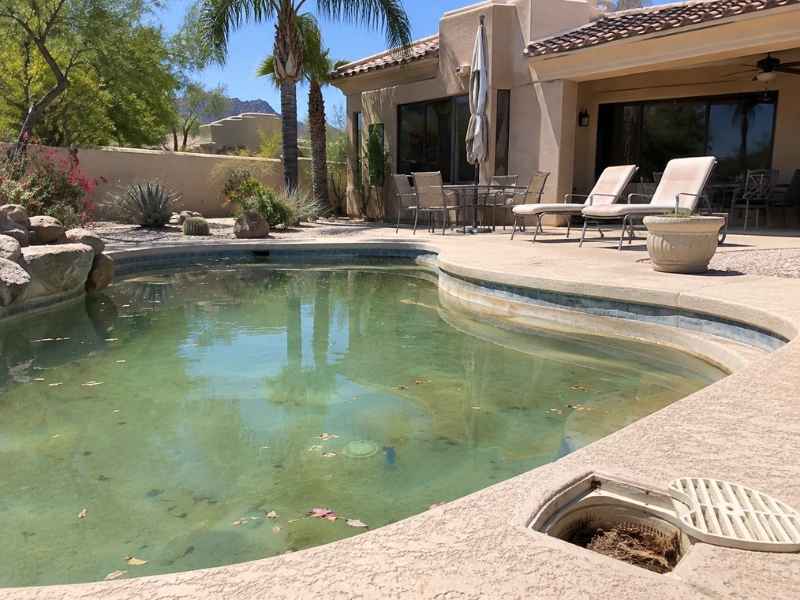
Pool inspections on a pool that's sat for months tend to turn up the same three things. Chemistry has wandered out of range, equipment grumbles or quits on restart, and nobody has looked at the safety items since spring. At a Scottsdale second home, most of that damage happens over the summer you're away. The heat, the dust and the monsoon storms don't care whether anyone is swimming.
By Alex & Jeff, Certified Home Inspector · Last updated November 20, 2026
Why does a pool left unused change so fast in the desert?
A pool left unused changes fast here because the desert works on it from every direction at once. Sun, heat, wind and evaporation keep going all summer, so the water and the equipment age while the house sits quiet.
Between May and October, an idle Scottsdale pool is dealing with:
Sun and heat that burn off chlorine, sometimes within days if there's no working feeder
Evaporation that drops the level, while the auto-fill tops it up with hard Valley water
Dust storms and monsoon rain dumping dirt, leaves and bugs into the water and skimmer
Storm power blips that reset timers or trip breakers, with nobody home to notice
It helps to know which kind of "unused" you're dealing with. Some pools get shut down completely, so nothing has moved for months. Others run on autopilot, with a timer and maybe a weekly service. The autopilot pool usually looks better in October, but it can still be hiding drifted chemistry and worn-out parts.
And a green pool isn't just ugly. Still water breeds mosquitoes, and Maricopa County Environmental Services says everyone is responsible for preventing mosquito breeding on their own property. So a forgotten pool can turn into the neighbours' problem too.
How does water chemistry after months of sitting go wrong?
Water chemistry after months of neglect goes wrong slowly, then very quickly. Once the chlorine runs out, algae and bacteria move in, and the other numbers drift in ways that eat at surfaces and equipment.
Reading | What happens while the pool sits | Why it matters |
|---|---|---|
Free chlorine | Burns off in the sun, often within days | Algae, bacteria and mosquito habitat |
pH and alkalinity | Drift out of range without regular adjustment | Etching, scaling and irritated skin and eyes |
Calcium hardness | Climbs as water evaporates and hard water tops it up | Scale on tile, heaters and salt cells |
Cyanuric acid (stabilizer) | Builds up if a tablet feeder kept dissolving | Chlorine works poorly, and partial draining may be needed |
Total dissolved solids | Rise with every evaporation-and-refill cycle | Cloudy water that's harder to balance |
Calcium is the one that catches Valley owners off guard. Evaporation leaves the minerals behind, and every top-off brings in more. So a pool can come out of a single summer noticeably harder than it went in. If you want to see where that leads after years, our guide to pools in older Phoenix homes shows what long-term scale looks like.
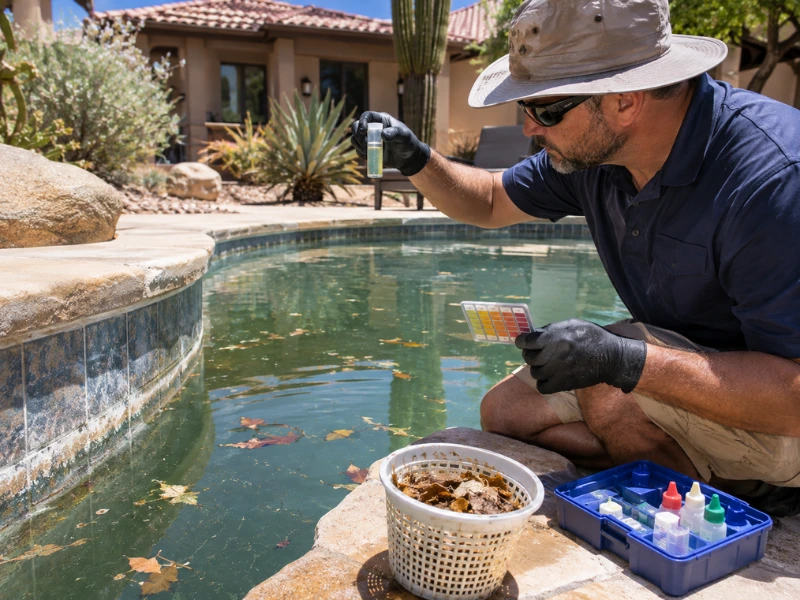
One thing to be clear about: a home inspection isn't a water test. Arizona's pool and spa standards for home inspectors don't require inspectors to test chemistry. We'll note the level, clarity and cleanliness, but balancing the water is a job for a pool service with a proper test kit.
Why do salt pools need their own check?
Salt pools need their own check because the cell only makes chlorine while water is flowing through it. Stop the pump, and the sanitizer stops too. Meanwhile, scale can build up on the cell plates, and some systems simply won't start again until someone cleans them.
Which parts of equipment that has sat idle fail first?
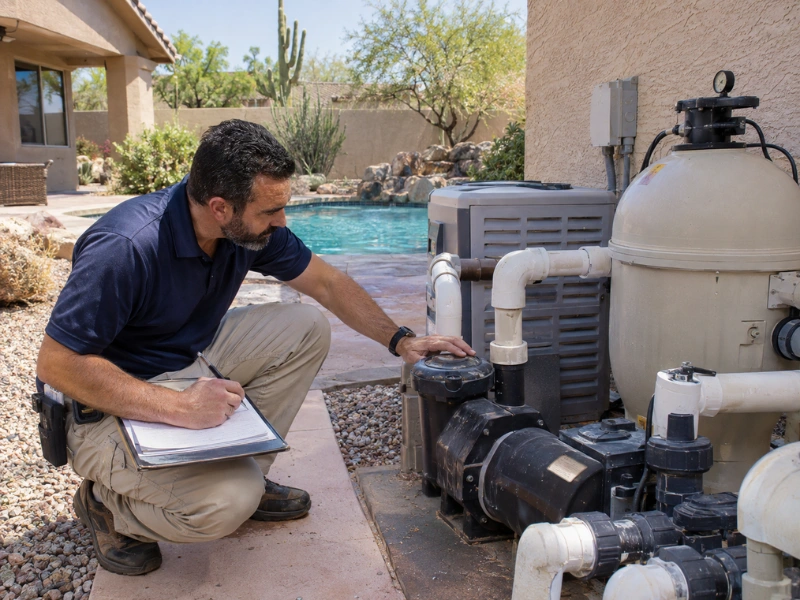
In equipment that has sat idle, the soft and electrical parts usually go first: seals, capacitors and anything with a small motor or sensor. The housings tend to be fine. It's what's inside them that dries out, seizes or loses its charge.
Pump seals and O-rings shrink as they dry, so a pump that was tight in May can drip the day it restarts.
Motor capacitors weaken after a summer in a hot equipment enclosure, and the motor just hums instead of starting.
Impellers and valves can seize from debris or mineral buildup, especially on a pool that was switched off.
Heaters pick up rust, spider webs and the occasional pack rat or bird nest in the burner area.
Salt cells and flow sensors scale up and throw error codes as soon as the system wakes up.
Automation and GFCIs can trip in a storm and quietly shut the whole pad down for weeks.
That last one causes more trouble than people expect. One tripped GFCI can turn a well-looked-after pool green between service visits. Often, the owner only finds out when they walk out back.
Got a pool that's been sitting all summer?
Call: (480) 273-9328
Hours: Mon–Sun, 6:00 am – 9:00 pm
Free estimate on your pool inspection
When should pool inspections happen on a seasonal home?
Pool inspections on a seasonal home work best two to three weeks before you're back. That gives you time to line up a pool service or a repair before you actually want to get in the water.
A check also makes sense:
right after monsoon season ends, once storm damage and debris have had a chance to show up
before you list or rent the home, so buyers and guests aren't the ones who find the problems
after a long power outage or a big storm, when the equipment may not have come back on properly
Say you're in Minnesota for the summer and need someone checking a pool that has sat unused at a Scottsdale second home. We can book the visit, do the walk-through and email you the report. Plenty of owners add a whole-home check at the same time.
You can make that visit far more useful with a little prep:
Leave the power on to the pool equipment, and label the breakers if you can.
Share the gate code or lockbox details so we can get to the pad and the yard.
Send along any service records from the summer, even a few texts from your pool tech.
Mention past repairs, like a new pump or a resurfaced shell, and roughly when they happened.
Then we can run the equipment on its normal controls and check it against the records. Anything that's changed since spring gets flagged. For the house side of things, our post on inspecting idle Scottsdale homes covers what a summer does to the rest of the property.
How do you read a pool inspection report on an idle pool?
Sort every finding into one of three piles: safety items to fix now, repairs to sort out before swimming, and things to keep an eye on. That stops a long report from feeling like one giant emergency.
Fix now: missing or damaged drain covers, gates that don't self-close or latch, and electrical problems around the pad.
Repair before swimming: leaking pumps, heaters that won't fire and lights that don't work.
Watch and maintain: surface stains, light scale and early wear on the coping or deck joints.
It also helps to know what an inspection can't see. Under Arizona's standards, inspectors run equipment on its normal controls. They don't pressure-test underground pipes or take equipment apart. So if the water keeps dropping faster than evaporation would explain, a leak-detection specialist is the next call.
Where do we offer pool assessments around Scottsdale?
We offer pool assessments in Scottsdale, AZ, and across the northeast Valley. Most of our seasonal-home work is in Scottsdale, Fountain Hills and Paradise Valley, where plenty of houses sit empty from late spring into fall.
If you're searching for pool assessments near Scottsdale and Fountain Hills AZ, these pages are a good place to start:
Scottsdale inspection services for second homes and condos with community or private pools
Fountain Hills inspection services for hillside lots, which often have longer pool plumbing runs
Paradise Valley inspection services for bigger estates with spas, water features and more complicated equipment
Our pool inspections page lists everything we look at. Really, the point of good pool inspections is simple: you find out what the empty months cost you before your first swim does.
Frequently asked questions
1. What happens to a pool nobody swam in for five months?
A pool with no circulation or chemicals usually turns green, loses water to evaporation and collects a layer of dust and debris, while one left running on autopilot often looks fine but has drifted chemistry and worn parts. What happens to a pool that is not used for months depends mostly on whether anyone kept the pump and chlorine going, so its history tells you as much as the colour of the water.
2. Does equipment fail faster from sitting still than from running?
Sitting still doesn't wear equipment out faster hour for hour, but it brings its own failures, like dried seals, weak capacitors and stuck valves. Pool equipment does fail from sitting idle, which is why so many pumps and heaters show their problems on the first restart after a long break.
3. What does it take to bring a neglected pool back?
Bringing a neglected pool back takes debris removal, a filter clean, a careful equipment start-up and several days of shocking and balancing, and very green or stained water may need a partial or full drain. How you restart a pool after a long break should start with the equipment rather than the chemicals, because a seized pump or leaking seal will undo all the water work.
4. Who should be watching it while nobody is here?
A weekly pool service is the best watcher for an empty home, since someone needs to check the chlorine, empty the baskets and make sure the pump is still running. A property manager or trusted neighbour should also have the gate code and your number, so green water or a broken fence gets reported before it becomes a bigger repair.
5. What is checked beyond the water itself?
Beyond the water, the inspection covers the pump, filter, heater, valves and visible plumbing, along with the shell, coping and deck. It also looks at safety items like the barrier fence, self-latching gates, drain covers, GFCI protection, bonding and lights, which are often the findings that matter most on a pool nobody has been watching.
Visit or Call Us
Halcomb Property Inspections
Phone: (480) 273-9328
Hours: Mon–Sun, 6:00 am – 9:00 pm
Family- and veteran-operated home inspection company
Serving Scottsdale, Fountain Hills, Paradise Valley, Phoenix and the wider Valley. Call for a free estimate, or use our contact page to book a visit.
