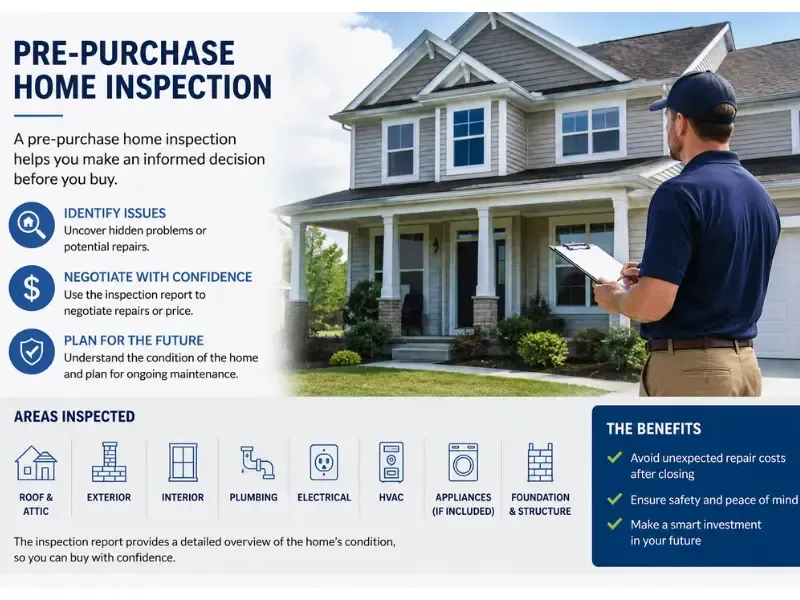
Why Does a Pre-Purchase Home Inspection Matter in Arizona?
Because Arizona puts the burden of discovery on you, and because the contract gives you a fixed and unforgiving window to act on what you find. A Pre-Purchase Home Inspection isn't really about peace of mind. It's about having evidence in hand while you still have leverage.
By Alex & Jeff, Certified Home Inspector · Last updated August 31, 2026
Why Do I Need One at All?
Why do I need a pre-purchase home inspection comes down to how Arizona allocates responsibility.
This is a buyer-beware state. Sellers have disclosure obligations, but no one is obliged to hand you a survey of the property's condition, and nothing about a well-presented house tells you what's behind the drywall or on top of the roof. A home inspection before buying is the only step in the transaction that exists purely to inform you rather than to move the deal along.
The second reason is timing. Your contract gives you a defined period to inspect and to raise what you found. Miss it and you haven't lost the right to know — you've lost the right to do anything about it.
How Does the 10/5/5 Clock Work?
This is the part that catches buyers, and it's worth learning before you're inside it.
The standard Arizona resale purchase contract sets an inspection period of 10 days from acceptance by default, though the parties can negotiate a different length. Everything else hangs off that.
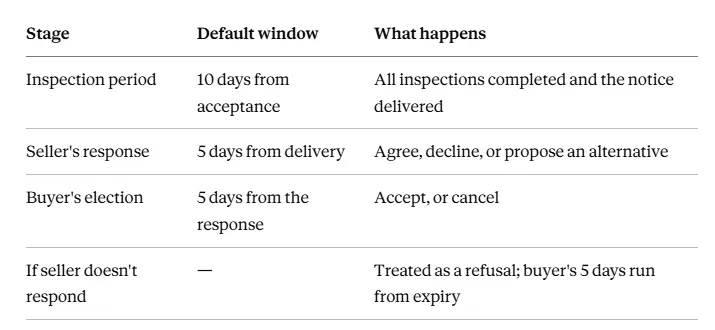
Book early in the period, not late. A buyer who schedules the inspection on day seven of ten has left almost no time to read the report, get costs on anything significant, and have their agent draft the notice. The clock doesn't extend because your inspector was busy.
All inspections must be done before you deliver the notice. The contract requires the disapproved items to come in a single notice — so if a general inspection points to a roof or a sewer scope, that specialist visit needs to happen inside the same window. This is why booking a buyer home inspection on day two rather than day eight actually matters.
Confirm your own dates against your contract with your agent. These are the defaults, not guarantees.
What Happens If Problems Are Found?
Nothing automatic, which surprises people. Finding a defect doesn't obligate anyone to fix anything.
What it does is open a structured negotiation. You deliver the notice listing what you want corrected. The seller then has three options, and the Arizona Association of REALTORS sets them out in its contract series: agree to correct everything, decline to correct anything, or respond with an alternative proposal — different terms from what you asked for, on the form or by addendum.
Then it comes back to you.
Seller agrees to everything. The transaction proceeds and the work is completed before closing.
Seller agrees to some but not all. You can cancel within five days of receiving the response, or accept the premises with only the items the seller agreed in writing to correct.
Seller declines, or simply doesn't respond. A failure to respond is deemed a refusal. You then have five days from the expiry of their response period to cancel or to proceed without the corrections.
Two things worth internalising. You get one notice — you cannot send a second, so a notice submitted on day six forfeits anything found on day nine. And "proceed without correction" is a real choice, often the right one: many findings are worth knowing about and not worth losing the house over. What the report buys you is the ability to make that call deliberately rather than in ignorance.
The AAR contract overview covers the inspection period provisions in full, and your agent is the right person to advise on strategy — repairs versus a credit is a genuine judgement call rather than a rule.

Why Should You Attend the Inspection?
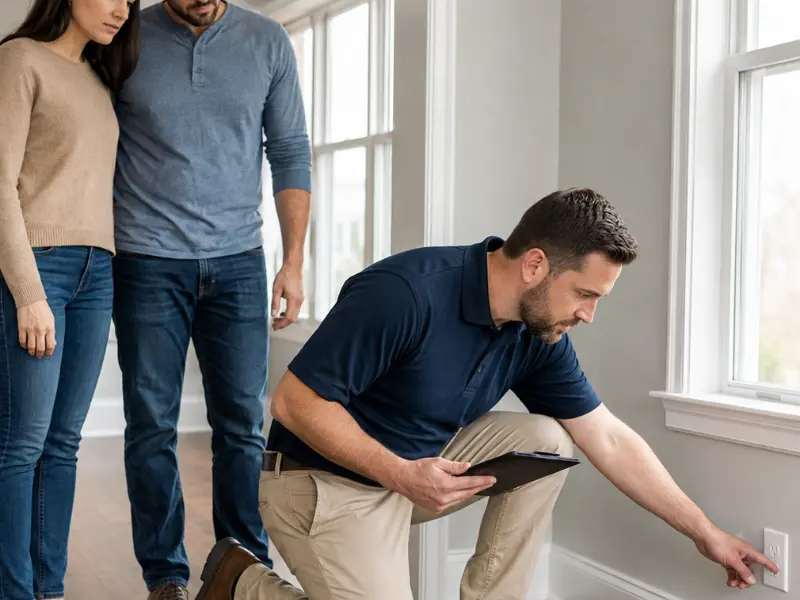
Yes, and I'd encourage it, with one adjustment: come for the last portion rather than the whole thing.
Following an inspector around for three hours produces less understanding than thirty minutes at the end, walking the significant findings with the person who found them. That's when you can ask the question that actually matters — is this a today problem, a five-year problem, or a note for the file? A report grades severity, but standing in front of something while someone explains it is what makes the grading stick.
On a Paradise Valley property, that final walk is more useful still, because there's more to see: multiple systems, outbuildings, hillside drainage. Bring the questions you care about. If you're worried about one specific thing — a stain, a smell, a crack you noticed at the viewing — say so at booking rather than at the end.
What Does a Pre-Purchase Inspection Include?
What does a pre-purchase home inspection include follows the standards Arizona certified inspectors work to, so the scope is consistent between providers: structure and foundation, roof covering and drainage, exterior and grading, attic and insulation, electrical service and panel, plumbing supply and drainage, water heater, HVAC in season, interior surfaces, and life-safety items.
Specialist scopes sit outside it and need booking separately inside the same window — pool and barrier assessment, termite reporting, and on many Paradise Valley properties the septic transfer inspection Arizona requires by rule, covered in our Paradise Valley home inspection guide. Our residential property inspections guide covers what to expect from the report itself and how Arizona certifies inspectors.
Worth adding on these properties: a roof inspection where tile underlayment age is unknown, an HVAC assessment where several systems are involved, and a foundation inspection on hillside lots.
How Much Does It Cost, and How Long Does It Take?
How much does a pre-purchase inspection cost in Paradise Valley tracks square footage, the number of separate structures, and how many discrete systems are present — a single-system house against a main residence with a casita, three HVAC systems, a pool and a workshop are different engagements. Specialist scopes are quoted separately. Estimates are free.
Set against the transaction, a pre-purchase inspection service is the smallest line item with the largest information value, and the only one you control entirely.
On duration: two to three hours for a typical single-family home, frequently half a day or more here. Reports follow within about 24 hours, which is deliberate — you're working against the clock above, not a leisurely schedule.
We cover Paradise Valley, Scottsdale and Phoenix, with scope on our residential inspections page and the area list on our locations page.
If you're searching for a pre-purchase inspection near Paradise Valley, or comparing a pre-purchase home inspection near me Paradise Valley AZ, book it in the first three days of your inspection period. A buyer home inspection Paradise Valley Arizona purchasers arrange early leaves room to act; one arranged late leaves room only to sign.
Frequently Asked Questions
1. Why is a pre-purchase inspection important?
Arizona is a buyer-beware state. Sellers carry disclosure obligations, but nobody is required to give you a survey of the property's condition, and a well-presented house reveals nothing about what sits behind the drywall or on the roof. The inspection is the one step in the transaction that exists purely to inform you. It also matters because of timing: your contract grants a fixed window to inspect and to raise findings, and missing it costs you the ability to act on what you learn rather than the knowledge itself.
2. How much does a pre-purchase home inspection cost in Paradise Valley?
Square footage, the number of separate structures, and how many discrete systems are present. A single-system home is straightforward; a main residence with a casita, three HVAC systems, a pool and a detached workshop is a substantially larger engagement and priced to match. Specialist scopes — pool and barrier assessment, termite reporting, and the septic transfer inspection required on many properties here — are quoted separately and, where Arizona licensing requires it, performed by separately licensed providers.
3. How long does the inspection take?
Two to three hours for a typical single-family home, and frequently half a day or longer on Paradise Valley properties, where large-lot custom houses bring multiple HVAC systems, guest houses, detached structures, pools and hillside drainage. Reports generally follow within around 24 hours, which is deliberate rather than incidental: the standard Arizona contract gives a ten-day inspection period, and you need time to read the report and act on it before that window closes.
4. Can I attend the inspection?
Yes, and it's worth doing — though the last portion is more valuable than the whole. Thirty minutes walking the significant findings with the inspector teaches more than three hours of following them around, because that's when you can ask whether something is an immediate problem, a five-year problem, or simply a note for the file. Mention any specific worry at booking rather than at the end, so it gets proper attention during the inspection rather than a glance at the close.
5. What happens if problems are found?
Nothing automatic — a defect obliges nobody to fix anything. It opens a negotiation. You deliver a single notice listing items you want corrected; the seller may agree to all, decline all, or propose alternative terms. If they agree to some but not all, you can cancel within five days of the response or accept with only the agreed corrections. A seller's failure to respond counts as a refusal, and your five days then run from the expiry of their window. Confirm all dates against your contract with your agent.
Contact Halcomb Property Inspections
Halcomb Property Inspections Serving Paradise Valley, AZ and the Phoenix metropolitan area Phone: (480) 273-9328 Hours: Monday–Sunday, 6:00 AM – 9:00 PM Serving Paradise Valley including the Camelback and Mummy Mountain areas, plus Scottsdale, Phoenix, and the wider Valley.
Just gone under contract? Request a free quote or call (480) 273-9328 — booking in the first few days of your inspection period is the single most useful thing you can do.
